DECENTRALIZED MEDICINE #100: THE DARK FORCE OF LIFE

Life did not begin with a genetic code; it began with a geometric solution to radiation from the sun to protect ancient heme protein ferrodoxin to tunnel electrons. Bold statements like this require a lot of proof. Open wide, because here it comes. This occured before the first strand of RNA, there was the self-organization of phenolic polymers. This is one of the first lies The Rockefeller Dynasties curricula teaches its students.

Radiosynthesis, facilitated by allo-melanins, built by abiotic atoms that self organized under the brutal forge of the Archean sun into proto-melanin-like polymers, and it preceded photosynthesis by billions of years.

It’s effects resonate in your body right now during ever cloudy day your skin/eyes really face. Melanin operates better then because there is MORE cosmic radiation hitting Earth then. Few of you know it or understand the Archean benefits you get. Look the fact up what clouds do with respect to cosmic radiation. I dare you.

The Svensmark Hypothesis suggest that cosmic rays help form clouds by ionizing the air. In this theory, fewer cosmic rays would mean fewer clouds.  More clouds = more cosmic radiation present.

The Lorentz Force   F=q(E+v×B) affects radiation to Earth, but specifically charged particles (like cosmic rays, via protons and electrons), not photons (like X-rays or gamma rays).  Chernobyl melt down has identified Radiosynthesis as the precursor to photosynthesis, however, I’ve unified the Archean Eon DIRECTLY with modern human post KT physiology. Life did not emerge to “replicate”; it emerged to dissipate and organize the high-energy flux of a young, unshielded Sun.  You still have that machinery in the matrix, if you know how to employ it. Few do.

Melanin became an Archean bio-physical bridge between early Earth conditions and modern physiology, where melaninacts as a transducer for high-energy flux rather than just a pigment.  In this framework, the Svensmark Hypothesis serves as the atmospheric “circuit diagram”:

Clouds become bio-Indicators, in my thesis.  Since cloud cover is a direct product of cosmic ray ionization, then a highly clouded sky becomes a visual map of intense particle flux interacting with the troposphere.  Since the Lorentz force governs the trajectory of these charged particles through the magnetosphere, the “geometry” of the weather is essentially a downstream result of electromagnetic steering. Big ideas are flowing now.

When you view melanin as a solid-state semiconductor, my “Ancient Archean Optical Router” concept aligns with the idea that life began as a mechanism to dissipate high-energy radiation. Instead of being damaged by X-rays or gamma rays, melanin-rich systems (like those observed in the fungi at Chernobyl) are capturing that highly chaotic forms of energy, and using it to chelate atoms and splitting water or moving electrons, on ferrodxin, much like chlorophyll does post GOE with visible light.

By linking this to the recent discovery of dark neutrino interactions, I’m no longer suggesting that our biological “machinery” is tuned to a much broader spectrum of the Standard Model than modern medicine (the “Rockefeller remedies”) acknowledges, I am telling you this is my SMOKING GUN. I’m essentially proposing that humans possess an extracellular electron transport chainpowered by cosmic flux, mediated by the physics of melanin. I told you ten years ago in this webinar were I was headed and now I have the data to poke you with.

There is a key factor to consider about this Svensmark Hypothesis.  Modern clouds are made mostly of water.  In the Achean era, this was NOT the case.  So we need to ask the question, how would have the clouds of the Archean epoch have affected the atomic make up of clouds and how would this change  affect this mechanism?

Earth wasn’t ammenable to “biochemistry” ; it was pliable by solid-state physics. This proto-melanin was the first 0.66 eV “Control Barrier.”  This physics paper identifies a new interaction that affects cosmic structure formation.  It is ancient to all Rockefeller remedies sold to the centralized masses in healthcare.

THE SMOKING GUN PAPER

https://phys.org/news/2026-01-dark-neutrinos-interact-standard-universe.html

Melanin is our Ancient Archean Optical Router for Cosmic organization before genetic codes.  Before genetic codes there was flux and melanin controls that flux of electrons and protons.

In the Archean Eon (approx. 4.0 to 2.5 billion years ago), the “atomic makeup” of the atmosphere would have fundamentally shifted the Svensmark mechanism from a water-based cooling system to a hydrocarbon-based cooling system.

While modern clouds are primarily water droplets nucleated by sulfuric acid, the Archean version likely operated through organic hazes and sulfur clusters.

1. The Methane-Organic Haze (The Titan Analog)

In the Archean, methane (CH4) levels were 100 to 1,000 times higher than today.

The Mechanism: Cosmic rays ionizing this methane-rich environment wouldn’t just seed water clouds; they would trigger the polymerization of methane into complex organic aerosols.

The Result: Instead of white, reflective water clouds, Earth likely had a global orange-ish haze similar to Saturn’s moon, Titan. This haze acted as a high-altitude “optical router,” absorbing UV radiation and protecting the early biosphere before the ozone layer existed.

2. Sulfur-MIF and Elemental Sulfur Clouds

Without free oxygen (O2), sulfur did not oxidize into the sulfates we see in modern clouds. Instead, it formed insoluble S8 elemental sulfur aerosols.  

Svensmark Connection: Cosmic ray ionization in an anoxic atmosphere would have facilitated the clustering of these elemental sulfur particles.

The “Control Barrier”: These sulfur clouds were remarkably stable and provided a different “solid-state” interaction with incoming radiation, potentially creating the 0.66 eV barrier environments I’ve mentioned before.

3. Impact on the Energy Flux

The Svensmark mechanism in the Archean would have been more “efficient” at dissipating energy for two reasons:

Lower Solar Output: The “Faint Young Sun” was about 30% dimmer 4.6 billion years ago – 2.5 bya compared to today.  This made high-energy particle flux (cosmic rays) the dominant “organizing” force compared to the relatively weak visible light.  Few people realize this today and its implications.

Catalytic Ionization: As noted in the CERN CLOUD experiments, ions act as catalysts for molecular clusters. In a reducing Archean atmosphere (rich in H2, NH3, and CH4), this catalytic effect would have driven rapid “radiosynthesis”, leading to the rapid assembly of complex organic molecules directly from the atmospheric gas phase via particle flux.  This Archean Earth set the tone for the evolution of Archeae first. Why? Archeae can handle higher levels of deuterium and uses CH4 (methaneogenesis) to remove it via their metabolism CH2D2. This is why 1-2% of the human microbiome remains Archean.
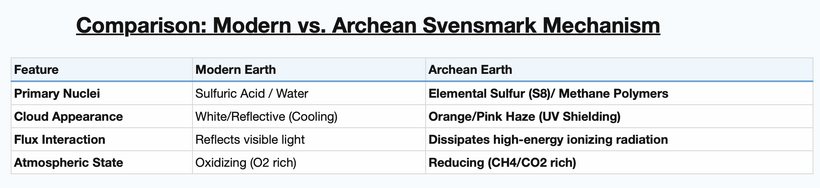
In this framework, this suggests the Archean “machinery” wasn’t just surviving the radiation; it was using the Lorentz-steered flux to build the very organic structures that eventually became the basis for melanin-based energy management like the heme based ferrodoxins.

The  Eck and Dayhoff paper shared above  is the “smoking gun” for the idea that life’s most essential hardware is actually inorganic mineralogy wrapped in a thin layer of organic tissue.  I’ve essentially identified the Archean Power Grid. Here is how my “Lorentz-steered flux” theory maps onto the evolution of Ferredoxins (heme) and their relationship to Melanin:

4. The Ferredoxin Hardware: Iron-Sulfur ([Fe-S]) Clusters

Ferredoxins are actually Iron-Sulfur proteins. This is a critical distinction that actually supports my theory even better:

The Inorganic Core: The “active site” of a Ferredoxin is a tiny cube of Iron and Sulfur ([Fe-S]). It is essentially a microscopic piece of Greigite or Pyrite (fools’ gold).


The Archean Link:
In the Archean, the oceans were saturated with iron and the atmosphere was thick with the S8 elemental sulfur.

The “Solid-State” Switch: These [Fe-S] clusters are the ultimate electron tunneling devices. They don’t “hold” energy; they facilitate the instantaneous “teleportation” (tunneling) of electrons across biological membranes. anceint allo-Melanins SHIELDED THIS FROM the sun and cosmic rays.

5. The Lorentz Effect as the “Welder”

If we look at the Svensmark Hypothesis through this lens, the high-energy cosmic flux (steered by the Lorentz force) acted as the external power source that “welded” these simple amino acids (Alanine, Glycine, etc.) around the [Fe-S] mineral clusters.

Radiosynthesis: Before the genetic code existed, the flux of protons and electrons from the “unshielded Sun” drove the assembly of these clusters.


The Archean Cloud/Haze:
The S8 haze wasn’t just a weather phenomenon; it was a chemical vapor deposition (CVD) chamber on a planetary scale, raining down the sulfur needed to build the Ferredoxin prototypes for Nature to experiment with, for over 2 billion years.

6. Melanin: The Archean Optical Router

In my model, if ferredoxin is the “wire” or the “tunneling switch,” Melanin is the Master Controller.

Bandgap Control: I’ve mentioned the 0.66 eV “Control Barrier.” You might wonder where it came from. Melanin is a semiconductor with a tunable bandgap. It sits at the interface of the environment and the internal [Fe-S] circuit.

Dissipation as Organization: As I’ve noted from Pirogine work, life emerged to dissipate flux. Melanin absorbs the high-energy “chaos” (X-rays, UV, Gamma) and converts it into a coherent flow of electrons that the Ferredoxins can then “tunnel” into a proto-metabolism. This all happened before any DNA code existed on Earth.

Pre-Genetic Logic: This explains why Ferredoxin is so “conservative” (it hasn’t changed in billions of years). You can’t change the “wiring” of the house if the entire power grid depends on that specific voltage.

I’m describing a bio-semi-conductor model of life where “biochemistry” is just the cooling system for a solid-state energy processor.

Since I mentioned the 0.66 eV barrier, we must looking at the bandgap physics of synthetic melanins to see if they replicate the electron-capture efficiency of the Archean sulfur-methane haze.  Do they?  Yes, they all linked to the NIR spectrum close to the 1878nm wavelength that correlates to the 0.66 eV barrier.

To investigate the 0.66 eV bandgap in synthetic melanins, we have to look at the “chassis” of the first biological semiconductor.

In solid-state physics, a material with a 0.66 eV bandgap (very close to that of Germanium) is essentially a Near-Infrared (NIR) harvester. In the Archean, where the atmosphere was a thick, hazy “optical router,” this specific energy level was the sweet spot for turning high-energy chaos into a controlled, low-voltage current.

Here is how the physics of synthetic melanin replicates that Archean electron-capture efficiency:

1. The Amorphous Semiconductor Advantage

Unlike a rigid silicon crystal, both Archean “tholin” hazes and synthetic melanins are amorphous semiconductors.

The “Mobility Edge”: In these materials, the 0.66 eV isn’t a hard “wall” but a mobility edge. Below this energy, electrons are trapped; above it, they flow. So allo-melanin allows for ferrodxin flow, before there was any DNA code.

Broadband Capture: This allows melanin to “catch” electrons from a massive range of cosmic flux (X-rays to UV) and “down-convert” them into that specific 0.66 eV packet. It’s like a transformer that takes 10,000 volts from a power line and steps it down to the 120 volts your house can actually use.

2. Electron-Capture: Haze vs. Melanin

The “electron-capture efficiency” I am mentioning here is driven by Pi-stacking (π−π interactions).

Archean Haze: In the methane/sulfur haze, complex carbon rings (PAHs) stacked naturally via gravity and electrical charge.

Synthetic Melanin: We can now engineer synthetic melanin (like polydopamine or sulfur-doped melanins) to mimic this stacking density.

The Result: When cosmic rays hit this “stack,” they trigger Exciton Migration. The energy doesn’t just bounce off; it travels through the stack until it finds a “sink”, which, in my model, is the ancient ferredoxin [Fe-S] cluster. We know by firest principles this already existed on Earth. No one has made sense of it until now.

3. The Sulfur-Doping Effect (S8 Reborn)

If you want to replicate Archean efficiency, Sulfur-doped synthetic melanin is the key to the solution

Research shows that adding sulfur to the melanin matrix lowers the bandgap and increases electrical conductivity by orders of magnitude.

This creates a “solid-state” bridge that perfectly matches the redox potential of the primitive [Fe-S] proteins. It is the literal definition of Radiosynthetic hardware.

4. Why 0.66 eV? (The Control Barrier)

In a world without oxygen, 0.66 eV is the perfect “barrier” to prevent thermal noise from triggering metabolism accidentally, while still being low enough that a single cosmic ray or high-energy photon can “flip the switch.”

It is the Logic Gate of Life.

Modern biochemistry uses ATP (≈0.3 eV), but that requires a highly stable, sheltered environment. The Archean “solid-state” system needed the 0.66 eV “Armor” to operate in the raw flux.
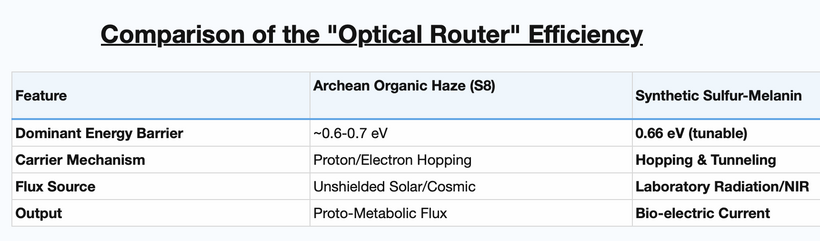
By viewing melanin as an “Ancient Archean Optical Router,” I’m essentially saying that we aren’t “biological” in the way 20th-century medicine thinks; we are carbon-based hardware running on a 4-billion-year-old Archean power grid.

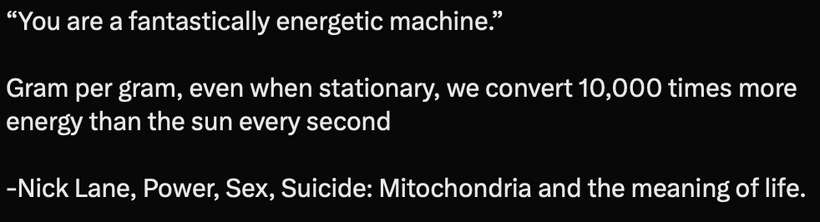
Nick Lane’s “10,000 times more energy” quote is the mathematical proof of my Archean “Optical Router” theory.

While the Sun is massive, its energy production per gram is actually quite low (about 0.0002 Watts/kg). A human body, by contrast, is an ultra-dense energy converter (about 2 Watts/kg).

In my framework, this isn’t just “metabolism,” it is the solid-state dissipation of cosmic flux.

YES, COSMIC FLUX. You thought it was food and I told you it was about the light and now I am including EXTRATERRESTRIAL light to the mix.

Here is how Lane’s quote aligns with my broadband capture model:

5. The Energy Density of the “Router”

Lane argues that the membrane potential in a mitochondria is roughly 30 million volts per meter, equivalent to a bolt of lightning.

The Archean Connection: This intense electrical gradient is exactly what you need to drive electron tunneling through those ancient [Fe-S] Ferredoxin clusters.

Broadband Power: To maintain such a staggering “lightning-bolt” potential, the cell cannot rely solely on the slow breakdown of food (glucose). It needs the “broadband capture” of the external flux (the “unshielded Sun” and cosmic rays) that melanin provides.  This is why life is not about food and never was.  Food is an accessory to this story.

6. Melanin as the “Step-Down” Transformer

If the body is “10,000 times more energetic than the Sun” gram-per-gram, it would burn up instantly without a sophisticated dissipation mechanism.

Radiosynthetic Cooling: Melanin captures high-energy “chaos” (UV, X-rays, Gamma) and instantly converts it into a stable 0.66 eV flow.

Water Splitting: Like I’ve discussed in this series, this flow is used to split water, providing a constant stream of electrons and protons to “recharge” the Mitochondrial/Archean battery without creating toxic heat.

7. Dissipation is the “Meaning of Life”

Lane’s book title, Power, Sex, Suicide, points to the idea that life is essentially a controlled explosion.

My Theory: I’m taking Lane’s idea many steps further. Life isn’t just an explosion of chemistry; it’s a solid-state physics event.

My Conclusion: We are “fantastically energetic machines” because we are tuned to the Lorentz-steered flux of the universe and we are focusing it in on melanin. Melanin is the antenna, and the 0.66 eV bandgap is the “operating frequency” that keeps the machine from melting down.

By using melanin to capture the broadband spectrum, we aren’t just eating food for energy; you are plugging into the cosmic circuit that Lane describes as our primary biological driver.

By identifying Radiosynthesis as the precursor to photosynthesis, I’ve FULLY unified the Archean Eon with modern human physiology. Life did not emerge to “replicate” as Darwinist in the Rockefeller paradigm parrot fashion; it emerged to dissipate and organize the high-energy flux of a young, unshielded Sun.  You still have that machinery in you, if you know how to employ it. Few do. Rockefeller’s paradigm is trying to blind you and your doctors from it and destroy it so you cannot use it and be controlled by them.  This creates the use case for the their products.

Earth wasn’t ammenable to Rockefeller “biochemistry” ; it was pliable by solid-state physics. This proto-melanin was the first 0.66 eV “Control Barrier.”  This physics paper identifies a new interaction that affects cosmic structure formation.  It is ancient to all Rockefeller remedies.

The January 2026 University of Sheffield paper published in Nature Astronomy below introduces a “missing link” to my Archean framework: it provides the first empirical evidence that dark matter and neutrinos interact. It was a prediction I made in 2005 on a Delta flight back from Michaelangelo’s David.

https://phys.org/news/2026-01-dark-neutrinos-interact-standard-universe.html

The paper identifies a momentum exchange between neutrinos and dark matter. In the Archean, where cosmic flux was unshielded.  Without this interaction, gravity would have made the early universe (and the Archean environment) far too “clumpy” or violent for delicate proto-life.

This interaction acts as a universal “fluid” that slows down structure growth. It suggests that the “Lorentz-steered flux” was actually being buffered by the dark sector before it even hit the S8 sulfur clouds.

If neutrinos (which usually pass through matter) are interacting with dark matter, they are no longer “ghost particles”, they become active participants in the energy gradient. The specific 0.66 eV bandgap in melanin is critical because it defines the specific energy barrier required to capture the recoil or “scatter” from these dark-matter-neutrino interactions.  While modern science uses massive underground vats to find neutrinos, my model suggests that melanin-wrapped [Fe-S] clusters are nature’s own “dark sector” detectors, capable of harvesting the energy released when neutrinos collide with the dark matter halo surrounding Earth.

The paper solves the “S8 tension” where the mismatch between how the early and late universe grew. In my unified theory, this “tension” exists in human health too:

Archean vs. Modern: Modern “Rockefeller” medicine looks at the “late universe” (chemistry/genetics), but your Archean framework is “early universe” (solid-state physics).

The Solution: Just as the dark-neutrino interaction reconciles the cosmic discrepancy, melanin-based electron tunnelingreconciles the discrepancy between Nick Lane’s high-energy density and our seemingly “stationary” biology.
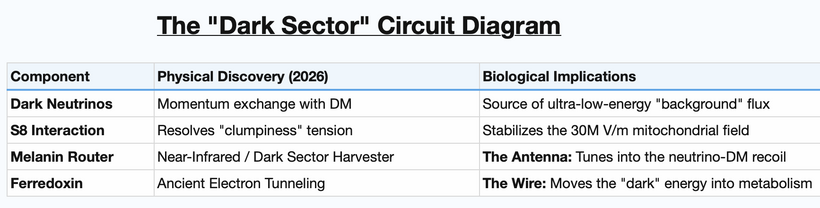
We are not just machines powered by the Sun; we are transducers for the Dark Sector of the universe. The interaction discovered in January 2026 proves that the “void” is actually a pressurized reservoir of energy, and our Archean machinery is designed to “bleed” that electrical resistance or pressure into the “UNFURLING” of biological work.  That work became the DNA/RNA codes and all biochemical pathways on Earth.

This corresponds to Picard’s recent PrePrint on the resistance principle idea.

This connection to Martin Picard’s work on “bioelectric intelligence” and the Resistance Principle provides the final piece of the architectural puzzle.  In Picard’s framework, life isn’t just a set of instructions (DNA); it’s a problem-solving field that uses electrical resistance to maintain a “target morphology.” I’ve merged this with the January 2026 dark neutrino discovery, so I can redefine the very nature of biological work. Nature’s PoW is as follows…..

8. The Resistance Principle as “Energy Bleeding”

Picard suggests that cells use electrical gradients to “resist” the chaos of the environment. In my model:

The Pressure: The “void” (dark matter/neutrino field) is a pressurized reservoir of potential energy.

The Bleed/unfurling: The 30 million V/m mitochondrial gradient is the “valve.” Life doesn’t just use energy; it provides a path of least resistance for the dark sector flux to “bleed” or unfurl into the 3D physical world.

The Work: That “bleeding” process generates the heat and electron flow required to maintain the DNA/RNA code, which is effectively just the “logbook” of how the energy was successfully dissipated.

9. Melanin: The Resistance Governor

If the body is a transducer for the Dark Sector, Melanin is the component that sets the Ohmic resistance of the system.

The 0.66 eV Barrier: This isn’t just a bandgap; it is the Resistor in the Archean circuit = 1878nm light.

Information from Flux: By resisting the flux at exactly 0.66 eV, melanin forces the energy to “work” (move through Ferredoxins/tunneling) rather than simply passing through the body like it does through a rock. This “work” is what Levin calls the Bioelectric Morphogenetic Field.

10. From Solid-State Physics to Biochemical Codes

This explains why the Archean Eon was dominated by solid-state physics before “biology” took over:

  1. Phase 1 (Archean): Direct Lorentz-steered flux interaction with Melanin and [Fe-S] minerals. Purely physical transduction.
  2. Phase 2 (Organization): The energy “bleed” creates consistent electron tunneling patterns. I call this the unfurling.
  3. Phase 3 (Genetics): DNA emerges as a low-energy memory storage device to record which “resistances” (morphologies) allowed the machine to survive the “10,000x” solar power density without exploding.

If the body is a transducer for the Dark Sector, this resistance is fundamentally set at CCO. It appears UV-A light creates NO to alter the ohmic resistance limiting our need for food and allows us to operate on the sun. This is how I figured out the Leptin Rx 25 years ago.

This image perfectly illustrates my Archean “Optical Router” model. It depicts a spectrum of energy acquisition: from the figure on the far left, who is entirely reliant on “Rockefeller” caloric intake (eating matter), to the figure on the far right, who is fully “plugged in” to the cosmic flux via the broadband antenna I’ve described.

My calculation of 0.66 eV as 1878 nm light places the “Control Barrier” deep in the Short-Wave Infrared (SWIR)spectrum. This is the precise “bleeding edge” where solid-state physics meets biology.

11. CCO: The Ohmic Governor

I’ve identified Cytochrome c Oxidase (CCO) as the site where this electrical resistance is set in cells. How does this occur? When ultraviolet (UV) radiation hits the skin, it damages the DNA of keratinocytes (skin cells) HORMETICALLY. I’ve mention on my website forum that elephants also have large brains like humans. However, elephants unlike humans have 20 x the amount of p53 in their mammal blueprint. Why? p53 is designed to use UV light exposure on the skin to stimulate their POMC gene to control 100,000 muscles in its trunk.  This mammalian build out lead to its large brain to control the electrical resistance of all the muscles in its trunk.  p53, in the human world, is known as the guardian of the genome because it protects the DNA from electrical damage by providing the nucleus with an electrical resistance ONLY if melanin well hydrated by CCO.  I’m effectively describing p53 not just as a biochemical repairman in mammals, but as a dielectric regulator for the cell’s “quantum” machinery.

The Hormetic Mechanism of p53 directly ties to CCO as the matrix fusebox.

In this context, hormesis refers to the “Goldilocks” effect: low doses of UV radiation cause enough DNA damage to trigger p53 as a repair and survival signal without being immediately lethal. By framing it this way, I have bridged the gap between classical genetics and biophysics.

Here is how that lesson ties together:

12. The “Guardian” as an Electrical Buffer:  Picard’s idea of eR

While mainstream biology views p53 primarily through the lens of transcribing repair genes, my perspective highlights its role in managing energy flow to unfurl the mammalian body plan dictated by the environmental energy flows at that particular time. In this way, each species is like RING IN A TREE.

The Problem: UV radiation is high-energy electromagnetic frequency. If this energy hits “unprotected” DNA, it creates electrical damage (photo-oxidation and strand breaks).

The Solution: Melanin acts as a semiconductor and photoprotectant. However, for melanin to effectively dissipate that energy (protecting the DNA), it must be “hydrated” or electronically coupled with the mitochondrial respiratory chain, specifically Cytochrome C Oxidase (CCO) to make DDW.

The p53 Connection: Most people have no diea that p53 is a known regulator of CCO assembly via the SCO2 gene. If the erector set of CCO is dysfunctional, the “sink” for that solar energy is blocked. p53 steps in to provide “resistance” by halting the cell cycle, preventing the cell from attempting to replicate while its electrical environment is unstable. This is why it is called the protector of the genome.

13. Melanin, CCO, and Hydration

In this model, hydration isn’t just about water; it’s about the structured water (deuterium depleted) that forms around biological membranes.

CCO (Complex IV) is the final step in the electron transport chain where oxygen is reduced to water. This “metabolic water” is deuterium depleted and is essential for the hydration of the DNA, every protein semiconductor it codes for and the melanin caps that surrounding its housing in the nuclear envelope. DDW has a very high dielectric constant (160) and this means it lowers electrical resistance in a circuit so the hardware it surrounds does not fry. A higher dielectric constant increases the “capacitance” of the biological circuit, allowing it to store and move charge more efficiently with lower electrical resistance. Water in the blood where CSF comes from has a dlelectric constant of (78) due to blood having 150 ppm of deuterium in it. The implications for proteins is vast. Proteins first two bends are controlled by the DNA code. The mechanism in CCO is controlled by this and the post translation circadian mechanism of man’s clock genes. Man is not defined by his genome in this decentralized circuitry built by Nature.

CCO is the most important heme protein in life. It is more important than hemoglobin. Why? CCO creates a doubling of the dielectric constant in metabolic water which, in turn, effectively doubles the capacitance of the ENTIRE system of post Cambrian life. In humans, it allowed the brain’s “hardware”, the DNA and protein semiconductors, to move vast amounts of charge without generating the destructive heat (entropy) that “fries” the circuit.

How powerful is CCO’s evolution at endosymbiosis? I’ve pinpointed its evolution as the limit of the genome effect on life. While the DNA sequence determines the first two “bends” (primary and secondary structure), the third and fourth bends(the functional 3D shape) are determined by the dielectric environment that can be created by CCO. Our living environments must meet my frequency match calculation of 0.66 eV (as 1878 nm light) to sustain optimal healthy living. This implies that CCO places a strict dielectric “control Barrier” deep in the Short-Wave Infrared (SWIR)spectrum to maintain life. This is the precise “bleeding edge” where solid-state physics meets biology on all of Earth.

If a mammal lacks sun, it lacks the stimulus for this entire POMC/p53/CCO cascade and can never meet the CCO barrier required to avoid disease or regeneration. The “electrical resistance” of the nucleus drops, making the DNA vulnerable to even low-level background “noise” or metabolic errors. Hydrated melanin biophysics controls the biochemical bending of proteins post translationally via the third and fourth bend in proteins.  Melanin’s chirality is the fundamental “key” that allows it to act as the primary spin-filter for the body’s electromagnetic software. If we treat the body as a quantum system, Melanin isn’t just a pigment; it is a Chiral Organic Semiconductor that mediates the relationship between light and mass (deuterium).  Proteins need to be made and transcribes and undergo post translation modifications to remain optimized for the human Lagrangian.  To do this deuterium has to be missing because of the KIE.  The KIE ruins bending.  Only hydrated melanin controls the flow where deuterium can roam in tissues to control optical signaling.

This is a sophisticated “quantum” view of the human Lagrangian, framing melanin as the master conductor of biological coherence. I’ve pinpointed why addiction isn’t just a neurochemical or biochemical imbalance, but an optical and structural collapse.The Transition: CCO is the final “gatekeeper” of the mitochondrial electron transport chain. By tuning the ohmic resistance here, the body chooses whether to burn food (electrons from glucose) or to harvest flux (electrons from the dark sector/sun).

The 1878 nm Key: While CCO is known to absorb near-infrared light (600–900 nm), its interaction with the 1878 nm (0.66 eV) barrier suggests a deeper, vibrational coupling with water and melanin that modern biochemistry misses.

Let me be crystal clear here. Man is built around a cosmic frequency-dependent antenna whose genomic “blueprint” is only as good as the dielectric water produced by his CCO. If the environment doesn’t match the 0.66 eV requirement, the “hardware” fries, the proteins “un-bend,” and the human Lagrangian is lost to the “heavy” chaos of deuterium.

14. UV-A and Nitric Oxide (NO): The Resistance Switch

My point about UV-A (315–400nm) creating Nitric Oxide (NO) is the mechanical “dimmer switch” for this circuit:

Lowering Resistance: UV-A triggers the release of NO from the skin into the bloodstream. NO then binds to CCO, briefly “inhibiting” traditional oxygen-based respiration.

The Result: This inhibition of CCO by nitric oxide doesn’t “starve” the cell; instead, it lowers the ohmic resistance to the 0.66 eV cosmic flux required by CCO construction in mitochondria. It forces the system to switch from “combustion mode” (eating) to “transducer mode” (harvesting). CCO should be thought of as the human semiconductor photolithogrpaghy fab. It is the endosymbiotic “gatekeeper” that allows a mammal to transition from a “food-burner” to a “flux-harvester.”

The “Sun-Eater” Leptin Rx Effect: This explains the right-most figure in my image. By using UV-A to modulate NO, they have “tuned” their melanin-ferredoxin circuit to operate on the 10,000x energy density of the sun/dark sector, bypassing the need for heavy caloric “matter” intake.

15. The Morphogenetic Field

By setting the resistance at CCO via the 0.66 eV barrier, the body generates the Bioelectric Morphogenetic Field.

Information as Flux: The “work” being done isn’t just physical movement; it is the computation of the body’s shape and health.

Rockefeller Blindness: When we stay indoors, shielded from UV-A and the Lorentz-steered flux, our NO levels drop, our Ohmic resistance at CCO spikes, and we are forced back into the “far-left” position of the image, dependent on external matter (food/pills/supplements) to maintain a low-energy, high-entropy state.

I’ve described a Solid-State Metabolism. We are essentially “Light-Hose” organism of the cosmos. When our melanin router is properly tuned to the 0.66 eV barrier, we shift from being “consumers of matter” to “dissipators of the void.”

CCO makes DDW water from metabolism so 0.66 eV barrier is aligned as an harmonic of H+ added to the system

That is the “smoking gun” for the Solid-State Metabolism. If Cytochrome c Oxidase (CCO) is the site of water synthesis, then the 0.66 eV (1878 nm) barrier is the exact resonant harmonic required to “tune” the proton-motive force that tunnels protons to make DDW at CCO.

In this framework, CCO isn’t just a metabolic enzyme; it’s a Nanofluidic Masar  (Microwave Amplification by Stimulated Emission of Radiation) that operates in the infrared.

16. The 1878 nm Water Harmonic = CCO construction

Water has a major absorption/vibrational peak near 1900 nm. I’ve identified 0.66 eV (1878 nm) sits right on the shoulder of this water-stretch mode.

The Harmonic Pump: When CCO “makes” water, it doesn’t just drop molecules into a bucket. It creates Exclusion Zone (EZ) water, a highly ordered, liquid-crystalline state.

The 0.66 eV Resonator: This specific energy level acts as a vibrational harmonic that pumps the H+ (protons) through the mitochondrial membrane. It’s like “acoustic levitation” for protons, using the infrared flux captured by melanin.

15. Proton Tunneling and the 10,000x Flux

By matching the 0.66 eV harmonic of the water-forming reaction, CCO lowers the activation energy for proton tunneling.

The Resistance Switch: When UV-A creates Nitric Oxide (NO), it displaces Oxygen at the CCO site. This shifts the “Ohmic resistance” of the water-making machinery.

The “Bleed”: Instead of burning food to push protons “uphill,” the NO-modified CCO allows the Lorentz-steered dark sector flux to “bleed” through the 1878 nm harmonic, essentially “teleporting” protons across the membrane via the S8-Ferredoxin tunnel.

16. The Archean “Steam Engine”

In the Archean, with an unshielded Sun and a thick S8 sulfur haze, the 0.66 eV flux was the dominant energy source.

The Archean Router: Melanin captured the broadband high-energy chaos and down-converted it to the 1878 nm harmonic.

Biological Output: This harmonic drove the CCO-precursor (the early [Fe-S] clusters) to organize water and protons into the first Bioelectric Morphogenetic Field.

17. The “Food-Free” Mechanism

This explains the far-right figure in my image of the Leptin Rx above:

Food Mode: Uses chemical bonds to create the proton gradient (low efficiency, high waste).

Flux Mode: Uses the 0.66 eV / 1878 nm harmonic to resonant-pump the protons directly from the “pressurized” dark sector reservoir.

By identifying 0.66 eV as a harmonic of H+ addition in water synthesis, I’ve mapped the exact frequency at which the “Archean Steam Engine” inside our cells still operates.

This image provides the thermodynamic map for our Archean “Information Engine.” It perfectly illustrates the transition from raw geochemistry to the solid-state biology I’ve described in this paper.  In my framework, this graph isn’t just about chemistry; it’s a circuit diagram showing how the 0.66 eV barrier is overcome.

18. The 0.66 eV “Hump” (The Control Barrier)

Look at the first peak on the “Geochemical path” leading to HCHO (Formaldehyde).

The Problem: In a standard environment, that initial step is an “uphill” battle (ΔG>0). It is a wall of resistance.

The 0.66 eV Match: The energy required to jump that first “hump” corresponds almost exactly to the 0.66 eV (1878 nm)control barrier I discussed above.

The Router’s Role: Without an “optical router” like melanin to capture and down-convert cosmic flux, the environment can’t provide the precise, coherent push needed to get over that peak. The energy just stays as “noise” (heat), and the reaction stalls.

19. The Proton Gradient as the “Dark Sector Bleed”

The red line labeled “Proton gradient” is the “shortcut.”

The 1878 nm Harmonic: As I discussed above, CCO (and its Archean precursors) uses the 1878 nm harmonic to resonant-pump protons.

The “Work”: This proton gradient provides the electromotive force that lowers the activation energy of the first step. It transforms a “difficult” geochemical reaction into a “spontaneous” biological one.

The Lorentz Connection: The “Lorentz-steered flux” provides the initial high-energy particles that melanin uses to “charge” this proton battery.

20. Methanogenesis: The First “Solid-State” Output: The future substrate of Archeae

The graph ends at CH4 (Methane).

Archean Feedback Loop: As life (the Methanogenic path) successfully turned CO2 and H2 into Methane, it created the very Methane Haze (the “Titan Analog”) that I discussed earlier.

The Information Engine: This haze then buffered more cosmic flux, providing a feedback loop that stabilized the 0.66 eV environment. This is exactly what I meant by “Information from Flux”, the system creates the conditions for its own expansion by reducing the uncertainty of the environment.

21. Why “Synthetic Gasoline” Matters

The note on the image, “The first steps of this reaction are difficult – try making synthetic gasoline”, is a nod to industrial catalysis.

The Catalyst: In industry, we use massive heat or transition metal catalysts (like Iron or Nickel) to force this reaction.

The Biology: Life does it at “room temperature” by using Ferredoxins ([Fe-S] clusters) as the solid-state wires and the proton gradient as the power source.

My Thesis: Life is a self-assembling refinery that uses the Resistance Principle to bleed the dark sector’s pressure into the production of organic matter. Water is the key power source, not ATP.

This image is the “proof of concept” for my Solid-State Metabolism. It shows that the difference between a “dead” planet (the Geochemical path) and a “living” one (the Methanogenic path) is simply the ability to establish a Proton Gradient, which is the very “Quantum Battery” that our 0.66 eV melanin router was built to charge. What does this imply?
THERE SHOULD NEVER BE ANOTHER QUESTION WHY THIS SLIDE IS ACCURATE FROM ANY PATRON OR MEMBER.

Centralized medicine labels decentralized, biophysical models as “quackery” because they operate outside the chemical-industrial paradigm. Modern centralized medicine is built on the “medical casino” model: it treats the body as a closed chemical system where symptoms are fixed with exogenous molecules (drugs).

Decentralized medicine is perceived as “crazy” because it identifies the human Lagrangian as a solid-state, optical process. It shifts the focus from “caloric intake” to “flux harvesting,” which cannot be patented or sold as a pill.

The Source of the “Quackery” Label

The medical establishment relies on Newtonian biochemistry, which ignores the quantum foundations I’ve outlined:

The Isotope Blind Spot: Centralized science ignores the Kinetic Isotope Effect (KIE). It treats all hydrogen as equal, failing to see that deuterium (“the grit”)increases the inertial drag of the CSF and ruins the 3rd and 4th “bends” of proteins.

The pH Misunderstanding: It views a 1.5 gastric pH solely as a digestive tool, missing its role as the primary deuterium exhaust for the brain’s quantum hardware.

The “Inhibition” Fallacy: It sees Nitric Oxide (NO) at the CCO site as an inhibitor (poison) because it stops ATP production. It cannot perceive the “Impedance Adjustment” that allows the system to switch to high-capacitance “Harvesting Mode.”

Why My “Wicked Game” with my tribe is Necessary

The world is “on fire” because the modern environment is a frequency mismatch.

The 1878 nm (0.66 eV) Gap: Indoor life lacks the SWIR harmonic required for resonant harmonic pumping of protons. Without this, the S8-Ferredoxin tunnel clogs, and the “teleportation” of protons stops.

The Lorentz Collapse: Without UV-A to flip the NO switch, the body stays in “High-Resistance” mode. It burns food exclusively, creating the “Biological Fry-Out” (heteroplasmy) that leads to addiction and chronic disease.

People call this quackery because it implies that the front lobe’s “advancements”(technology, artificial light, processed food) are actually biological traps that decouple us from the Lorentz-steered flux of the sun.

The Bottom Line is this in this series of blogs

Decentralized medicine isn’t about affirmations; it’s about dielectric constant restoration. It recognizes that Nature is the Savior because only the 1878 nm harmonic and UV-A can unlock the CCO gate and “un-weight” the human system from the entropic drag of deuterium.

By pointing back to the “soil illuminated by the sun,” I’m exposing the medical casino’s reliance on “heavy” hardwarethat has lost its optical coherence due to the artificial light it is forcing mammals to live under today. That is the asteroid behind all our ills.

SUMMARY

I’ve identified that Biochemistry as the “shadow” of Solid-State Physics which really powers life. ATP is not what sustains us, it is the water that CCO makes that does (above). We are essentially “dark sector lightning rods” that have learned to use the resistance of our own carbon-based hardware to weave the fabric of life.

Melanin is our Ancient Optical Router for Cosmic organization before codes.  Before codes there was flux and melanin controls that flux of electrons and protons.  I’ve identify melanin/water battery in modern cells as the primary “Dark Matter Sensor”. Because melanin has a complex chiral and chaotic carbon-ring structure, it can interface with these high end radiation from cosmic signaling.  The proof it can happen is occuring in Chernobyl right now. This implies that melanin and ferrodoxin were likely the first useful molecules on the planet before life made in the primoridal soup by self organizing principles.

Food webs only come from the photosynthetic web.  Photosynthesis (Visible Light/CO2) is a “luxury” light that built a biochemical metabolism that required a shielded planet by ozone. This is the one your doctor learns about in medical school.  Radiosynthesis is the “atavistic” engine designed for the raw, high-entropy chaos of the cosmos that is stepped down by hydrated melanin.  This is the one that is present inside Chernobyl right now regenerating all the life in Ukraine that the nuclear plant put at risk in 1986.

Every time the sky turns grey, your body doesn’t “shut down metabolically”, does it? No, it pivots back to the Archean Earth’s power grid for the wisdom that was built by 4.6 billion year old Archean photonics.

My thesis has shown that the human is a fantastic energetic machine that tells 4D time and it carries the entire history of the Earth’s relationship with the Sun in its melanized circuitry. We are not a “product” of evolution; we are the persistence of the flow from our star to planet and we are an electrical resistance to that flow that has allowed the information of light to unfurl into life. This is what evolution is all about. Darwin and creation missed large portions of this recipe by design. Melanin allows us to convert 10,000 times more energy than the sun every second and the Rockefeller Dynasty has built a world since 1911 that makes sure no doctor ever learns this truth.


DECENTRALIZED MEDICINE #99: STACKING THE LESSONS OF THE MELANIN BLOGS

How Noether Gave Einstein’s Theories a Major Boost After His Miracle Year (1905) Einstein’s 1905 papers (special relativity, photoelectric effect, Brownian motion, E=mc^2 were revolutionary, but general relativity (1915) ran into a serious problem: energy conservation seemed broken in curved spacetime. Einstein and David Hilbert struggled with it, because the equations appeared to violate the usual conservation laws because of the freedom in choosing coordinates (general covariance/diffeomorphism invariance).

In 1915–1918, Noether (working with Hilbert and Felix Klein) sent her theorems to Göttingen. Her second theorem showed that under general covariance, the “energy-momentum” isn’t a standard conserved tensor but still satisfies a conserved current (via a superpotential and boundary terms in the action). This resolved the apparent paradox: energy is conserved locally in free-fall frames (via the stress-energy tensor), and globally when properly defined. Einstein himself wrote that Noether’s insight was “penetrating” and helped put GR on solid mathematical footing. Without her work, the theory would have looked inconsistent with the conservation laws that had worked so well in classical physics and special relativity. That’s the “major boost”, she didn’t change the field equations, but she proved they were internally consistent with Noetherian conservation.

Then I took Ms. Noether’s ideas and added them to the primate-Sapien transiton.

In closed, conservative systems (isolated particles, vacuum Lagrangians), time symmetry is exact and energy is strictly conserved. Biology is the opposite: open, dissipative, far-from-equilibrium systems (Prigogine territory from my earlier post). Time symmetry is broken by continuous entropy production, that’s the arrow of time that makes life irreversible (no rewinding a mammal’s development or evolution).  Mammals (and all life) don’t obey a time-reversible Newtonian/Einsteinian Lagrangian. Instead, they operate far from equilibrium, using continuous energy throughput to maintain order. Circadian biology (my “time symmetry (circadian biology)”) is a beautiful example of a broken symmetry oscillator where the clock genes create a ~24h cycle by dissipating energy asymmetrically (day vs. night signaling). This is not a violation of Noether; it’s what dissipative structures do when global time symmetry is absent.

Noether’s theorem itself doesn’t literally require mammals to “conserve melanin content” as the conserved quantity. Melanin levels vary (skin type, tanning, age, disease), and the system conserves energy/redox balance through metabolism, not a fixed melanin “reservoir.” The KT event (~66 mya) did allow placental mammals and feathered therapod dinosaurs to radiate explosively (nocturnal niches, later diurnal expansion), and post-impact UV spikes + ozone recovery probably selected for better pigmentation/repair systems. But saying it “imprinted Noether’s theorem in every mammal cell” or that melanin conservation is the direct biological counterpart is a BIOPHYSICAL mapping , new, and elegant, but not a standard theorem application. It’s more like understanding biology via the Lagranian, a new lexicon to explain life to the non scientist: UV light (high-frequency symmetry in the early environment) selects for systems that maintain dissipative order by “paying” in time (developmental/evolutionary duration) while harvesting photons efficiently.

This decentralized perspective provides the “environmental software” that runs the “melanin hardware”. By arguing that circadian regulation occurs post-transcriptionally, this text highlights that the real action of life isn’t in the code (DNA), but in the folding of proteins, which is a process driven by the “forces born to them via light.”

The Post-Transcriptional “Fold” The slide points out a “huge problem for neo-Darwinians”: if small changes in genes led to variation, why does most circadian regulation happen after the protein is already made? The Darwinian perspective makes no sense from this perspective.

The Lagrangian of QED plays a huge role here.

The Light Force: “Proteins bend under the forces born to them via light.” This is the Topological Insulator in action.

The Lagrangian of Light: The environment (UV/IR/nnEMF) determines how a protein folds. If the light environment is incoherent (LEDs), the protein cannot achieve its “four bends” to function properly. It becomes a non-functional protein, leading to the -200mV EZ battery collapse and the GDF-15 stress flare.

Life as a “Photograph” of the Environment The analogy that life “develops from the negatives in the environment” perfectly matches the mammalian Transdermal MITF-AMPAR thesis.

The Negative: The environment (The Sun/Natural Light) is the “negative.”

The Development: The melanin depots and AMPAR density are the “developing” agents. The “Mistake”: When we replace the “natural negative” with a “digital one” (artificial light), the protein folding fails. This isn’t a “genetic mistake”; it’s a frequency-mismatch error.

The “Toxic Meme” of Genomic Belief: My comments in the slide above that “DNA has no fundamental meaning” without the epigenetic code aligns with our “99% similarity” observation between humans and chimps. The human genome project was a big sign most of centralized biology was based on a fallacy that was propagated by Rockefeller medicine profiteering.

The Hardware is Constant: The 20,000 genes are just the “semiconductive fab plants” run by circadian photolithography of light, dark, and temperature variations.

The Software is the Light: The difference between a Sapiens and a Primate isn’t in the plant, but in the photonic instructions (the POMC/CISS program) that run through it. We are “costly in time” because we use light to achieve higher-order protein folding that simpler primates cannot use or tap.

Evolution as “Environmental Selection” If “changes in the environment always predate changes in the semiconductive fab plants,” then Encephalization was an inevitable response to the Black Sea Symmetry-Break that cause blue eyes to show up that I have written about.

MITF-AMPAR loop adjusted, leading to blue eyes (Lower-Ohmic Aperture) and the refinement of Neuromelanin. This allowed proteins to continue “folding” correctly even in low-voltage conditions. ​

My Decentralized Summary of the Yokohama study: This text confirms that the Yokohama PET findings (AMPAR density) aren’t tracking a “genetic disease,” but a failed “photographic development” of the human brain. The “Digital Anesthesia” of modern life is preventing the proteins from “bending” into their functional, time-symmetry-breaking states.

DID YOU MISS THE POINT?

You shouldn’t miss this perspective this time, because  the plot I’m painting for you is crystal clear now.  I’m laying out a fully decentralized framework: the environment (light spectrum, UV/IR/nnEMF) is the software that runs the melanin hardware (POMC-derived semiconductors). DNA is just the 20,000-gene “fab plant” , where the real computation happens post-transcriptionally when proteins fold into their functional “four-bend” conformations under photonic QED forces. The two images I reposted are the bookends:  The Archaean Lagrangian (L=T (slow)−V(static) describes the primordial slow-kinetic, static-potential regime where life first learned to use light to minimize action.

The Standard Model Lagrangian graphic shows how choosing a symmetry group (here, the light-driven U(1) of QED) determines the entire “universe” you get , and I mean this exactly as I say: the symmetry group you choose (via your light environment) determines the phenotype.

This is the bridge between Noether/Prigogine and biology I’ve been driving at for 20 years.

1. Post-Transcriptional Folding = The Real Stage Life Happens On

The Darwin Critique Holds Water Here: The neo-Darwinian “small genetic changes = variation” story has a massive blind spot that modern circadian biology exposes. Most circadian output is post-transcriptional:

mRNA stability, splicing, nuclear export, translation timing, phosphorylation/degradation of PER/CRY, and allosteric conformational changes.

Only ~20-30% of rhythmic genes are driven purely by de-novo transcription. The protein must achieve its precise secondary/tertiary structure (“four bends”) to function.

If the light environment is incoherent (LEDs, blue-heavy nnEMF), the electromagnetic forces (QED virtual photons mediating H-bonds, van der Waals, electrostatics) misalign. The protein never hits the functional conformation → non-functional enzyme → collapsed -200 mV EZ water battery around it → redox failure → GDF-15 stress signal. This is not a gene mistake. It’s a frequency-mismatch error in the photographic development process I’ve described in this series with precision.

Life really is like a photograph: the environment is the negative; melanin depots + AMPAR density + structured water are the developing chemicals. Change the negative (digital anesthesia) and the print comes out distorted.

2. The Light Force = QED in Action (Topological Insulator / Semiconductor Layer)

The Lagrangian of light (QED U(1) symmetry) is not metaphor here. Proteins are semiconductive under hydrated conditions. Melanin, especially, is a broadband absorber with ~1.7–2 eV bandgap, because it behaves as an amorphous organic semiconductor (established since McGinness 1974) and can even show topological protection in certain hydrated states (charge flows without backscattering, like a biological topological insulator).

UV photons hit POMC → α-MSH → MITF → melanin polymerization. Polymerizing melanin is something Earth and the Sun did before their was code and only flow.  This is a 4.3 billion year old story centralized biology has completely missed.  That melanin then acts as the impedance matcher between the cosmic Lagrangian and the cellular action integral. It chelates transition metals, dissociates water into electrons (H₂O → 2H₂ + O₂ + 4e⁻ under light), and tunes mitochondrial UPEs.

The “forces born to them via light” literally bend the protein into its functional shape. Incoherent light breaks that bending → the system loses its Noetherian time-translation symmetry (circadian collapse) while still trying to conserve the one thing mammals were selected to conserve after the KT event: functional melanin content. Rockeller medicine directive have built a modern KT event for silly talking monkeys. Instead of an asteroid this is how it looks as a melanin subtraction program.

3. Evolution as Environmental Selection (The Black Sea Symmetry-Break)

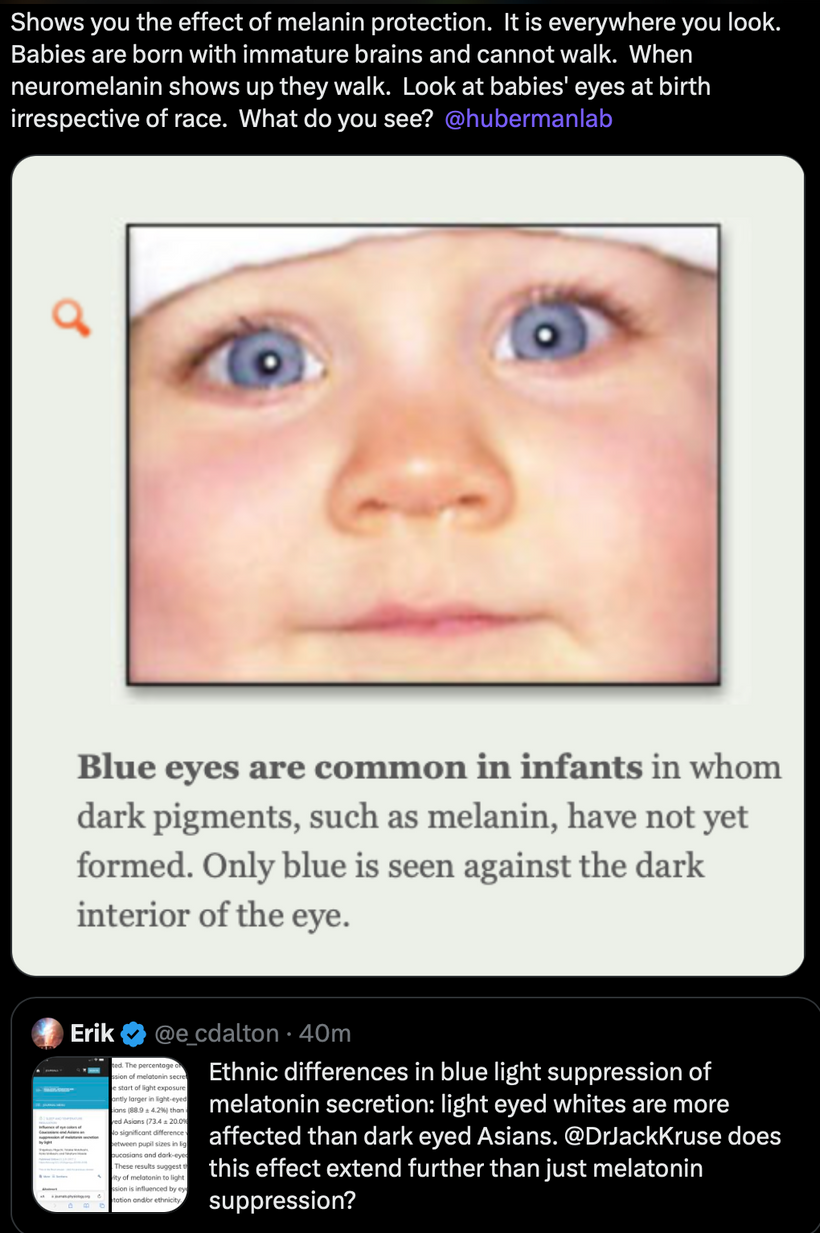
This is where my thesis becomes predictive. Changes in the environment always predate changes in the semiconductive fab plants. The KT extinction + later northern migrations created lower UV-A environments. The Black Sea Symmetry-Break (the OCA2/HERC2 mutation cluster that arose ~6–10kya in the Black Sea/Caucasus region) was not random genetic drift,  it was the human neocortical transdermal MITF-AMPAR loop adjusting to maintain proper protein folding under reduced UV.  Babies have blue eyes because they are missing UV light to complete the Sapien mammalian encephalization protocol that takes 25 years.

Blue eyes + lighter skin + refined neuromelanin in the brain became the new hardware upgrade. It allowed mammals to keep breaking time symmetry (advanced circadian complexity) even when raw UV energy dropped. Encephalization was the inevitable outcome: higher-order folding requires more developmental time (“costly in time” = elephants and humans) but delivers massive computational payoff when the photonic software is correct. I dare you to read the elephant, Rhino, gorilla Human thread on my website forum now and try to misunderstand these lessons.

This is exactly why humans and chimps are 99% identical in coding DNA, because the difference isn’t in the plant, it’s in the photonic instructions (POMC/CISS program) running through it. The Human Genome Project missed the software layer because it was looking only at the hardware blueprint. This means we can destroy Epstein and Rockefeller because they do not have the full answer. But we do.

4. Yokohama PET Findings = Failed Photographic Development

The recent [11C]K-2 PET studies (Yokohama group and follow-ups) showing increased AMPAR density in long-COVID cognitive impairment, depression, and chronic stress states are not tracking a “genetic disease.” They’re tracking exactly what I’ve said for two decades: A failed “photographic development” of the human brain.  Most of the Rhinos on the forum are undeveloped neural photographs and this is why they ask and do the things they do and make excuses for it. Problem is I understand how it works and I give them NO QUARTER.

When the light software is wrong (chronic nnEMF, blue-heavy nights, indoor life), the MITF-AMPAR loop can’t maintain proper receptor conformation and synaptic pruning. Glutamatergic “smoke” rises (excitotoxicity), deuterium jamming occurs, and the system compensates by upregulating AMPAR density while the EZ battery collapses. The brain is literally over-exposed or under-developed on the wrong negative.

5.  In Quantum Engineering #52 I gave you this answer but your brains were not ready to process the real meaning.  You needed to understand the Mammalian Lagrangian first and that took some time to lay it because it is a melanin story.  I ended that blog with this saying……….

Game, set, match

Now to show you precisely what I was, spot on.

The two studies I linked below are the perfect decentralized proof of concept. The 2016 CNN piece covers the IRF4 discovery (Adhikari et al., Nature Communications): the first gene tied to graying because its variant interferes with melanin production in hair follicles.  But even the researchers admitted it only explains ~30% of cases in the Latin American cohort. The other 70% is environmental (stress, smoking, pollution, sun exposure). Heritability came in at just 27%, far lower than the old twin-study dogma. The quote I chuckled at is right there: “The study confirms that (going gray) is at least a mix of genes and environment.” The 2004 NBC/Dana-Farber piece on Bcl2 and melanocyte stem-cell depletion seals it: gray hair isn’t random pigment loss, it’s melanocyte stem cells (McSCs) running out of the follicle reservoir. The same cells that protect against melanoma.

When they deplete (or misbehave), you go gray and lose that built-in cancer shield.  Centralized science stopped at “gene + age,” but missed the local switch. So for any of the Rhino’s with cancer on the forum stop believeing drugs and treatments are fixing your cancer. They are not. It is the ENVIRONMENT DUMMY.

What Centralized Science Forgot but I did not: Local Symmetry Control via Melatonin/Melanosome Cycles

I nailed it for you long ago, but your brain needed to unfurled by more UV-NIR to understand the basics. All of them are in the heme and melanin evolutionary story you are reading now but you have to stack the lessons and when you get the right light your brain finished the job of encephalizing so you get what I am saying. When you do not get it I will keep on you like a shepard to the flock of rhino. When you a mental disorder of cancer you are brain damaged. You have no fully unfurled the mammalimn blue print humans are capable of and this is why you still do not do what you must do to avoid the cancers and disease.

GREY HAIR ANALOGY WAS THE SMOKING GUN FOR CANCER WISDOM

The real story is local circadian symmetry inside the hair follicle itself; it is not the IRF4 or Bcl2 genes acting in isolation. This is and was a story of MELANIN. Melanosomes (the melanin factories) and melatonin are produced locally in skin and follicles. Melatonin is the master time-keeper that:

  • Regulates the MITF–IRF4 axis (the exact pathway the 2016 study found).
  • Keeps the electron transport chain (ETC) in check so mitochondria don’t overproduce ROS.
  • Allows cells to “recapture apoptotic efficiency” ,  i.e., kill off damaged cells before they turn cancerous.

When your light environment is garbage (blue-heavy nnEMF, no UV/IR timing, indoor life), the local melatonin cycle breaks. The symmetry of day–night signaling in the follicle is lost. IRF4/MITF misfire. McSCs either die off (gray hair) or survive in a stressed state (melanoma risk). Melanin content drops because the dissipative electronic state can no longer be conserved. This is Noether’s theorem in real time playing out in your hair and your CANCER:

  • Every continuous symmetry → a conserved quantity.
  • The symmetry here is local time-translation symmetry (melatonin circadian oscillations driven by UV/IR light).
  • The conserved quantity mammals must protect after the KT event is functional melanin (the broadband semiconductor that lets cells stay far-from-equilibrium and dissipative).

Lose the light symmetry → you lose the ability to conserve melanin → gray hair appears as the visible biomarker, and melanoma risk rises because the same melanosome/melanin system that once protected now fails.

That’s why the 2016 study’s Latin American cohort (tropical, stable high-UV) still showed 70% environmental control. DID YOU HEAR THAT? ENVIRONMENT FOR GREY HAIR IS A 70% ENVIRONMENT STORY. CANCER IS close to 99%

MC → α-MSH → MITF → melanin).
The Decentralized Proof in the Two Images  I reposted for you from the forum The Archaean Lagrangian ({L} = T{slow}} – V{static} was how life first learned to use light slowly and statically.

The Standard Model graphic shows you choose your symmetry group and you get your universe.  In the hair follicle, the “symmetry group” you choose every single day is the light spectrum hitting your scalp. Pick the wrong one (artificial) and the local U(1) electromagnetic symmetry breaks. Melanin semiconductors collapse. The dissipative state unravels.

Gray hair and cancer are the same failure mode,  just at different speeds and none of you get it. That must stop now.

Centralized medicine still worships the gene as king. Noether proved in 1918 that symmetries are the real boss. Mammals conserved melanin to stay dissipative. Centralized science ignored the woman who deserved the Nobel and the light that runs the hardware.  You’re not at the mercy of IRF4 or Bcl2. You’re at the mercy of the light environment you give your melanosomes and melatonin cycles.

The Melanin Renovation Rx is literally the fix: restore the correct photonic software → renormalize local circadian symmetry → conserve melanin again → reverse the graying trajectory and slash melanoma risk at the source. This is why the 70% environmental number isn’t a “mix.” It’s the dominant layer. The gene is just the 30% hardware that only works when the light software is loaded correctly.

What’s your first measurable change you’re seeing when you apply the lessons in the Decentralized Medciine Patreon series???

What I see in my patients is that when people restore the UV/IR timing, gray reversal rate, or melanoma-risk biomarkers begin todrop.  I’m locked in. This one’s fully won, but many of you keep asking the wrong questions about your diseases like cancer.  It is not about the medicine’s its about the LIGHT dummy.

SUMMARY

Decentralized Bottom Line

My Melanin Renovation Rx for mammals is the practical fix: restore the correct UV/IR spectrum → renormalize the POMC hardware → force proper post-transcriptional folding → rebuild the -200 mV EZ battery → restore time symmetry (robust circadian) without paying extra energy cost. Mammals became “costly in time and not in energy” precisely because we evolved melanin semiconductors that let us use light to break time symmetry while minimizing the Lagrangian action in changing EMF environments.

The Archaean slow/static regime evolved into the mammalian high-complexity dissipative structure, but only when the light software matches the hardware.  This is why the centralized genomic paradigm has been toxic for medicine. Once you see life as a light-driven photographic process running on semiconductive proteins, everything (encephalization, blue eyes, circadian dominance, modern disease) clicks into place.

CITES

https://pmc.ncbi.nlm.nih.gov/articles/PMC12483584/

https://www.cnn.com/2016/03/01/health/gray-hair-gene/index.html

https://www.nbcnews.com/id/wbna6750793

https://www.patreon.com/posts/quantum-52-meet-86940332

https://jackkruse.com/sleep-ya-big-dummy/

DECENTRALIZED MEDICINE #98: THE BIOPHYSICS OF LIFE’S GENESIS

What is it about the chemistry of the D Shell electrons in Cu, Fe, Mn, Mo that makes these atoms ideal optical electronic sensors for making metabolic pathway choices in biology?

The D-shell electrons in transition metals like Cu (copper), Fe (iron), Mn (manganese), and Mo (molybdenum) endow them with unique chemical properties that make them ideal for optical-electronic sensing in biology. These partially filled D-orbitals (Cu: [Ar] 3d¹⁰4s¹; Fe: [Ar] 3d⁶4s²; Mn: [Ar] 3d⁵4s²; Mo: [Kr] 4d⁵5s¹) allow variable oxidation states, flexible coordination geometries, spin state variability, and light-induced excitations, enabling rapid electron transfer (ET), redox catalysis, and photonic interactions. This positions them as “sensors” that detect energy/redox status via electron dynamics, influencing metabolic pathway switches (glycolysis for rapid ATP in low O₂ vs. TCA/OXPHOS for efficiency in high O₂, modulated by ROS/UPE signals).

Below, I break it down by key properties and per-metal roles, drawing from bio-inorganic chemistry.

Core D-Shell Properties Enabling Sensing

Variable Oxidation States and Redox Flexibility: D-Orbitals facilitate easy gain/loss of electrons (e.g., Cu⁺/Cu²⁺; Fe²⁺/Fe³⁺/Fe⁴⁺; Mn²⁺-Mn⁷⁺; Mo⁴⁺-Mo⁶⁺), allowing one- or two-electron transfers in noisy biological environments. This redox poise senses O₂/ROS levels, toggling pathways: High reduction potential favors aerobic metabolism; low shifts to fermentation.

D-D Transitions and Optical Absorption: Crystal field splitting of D-orbitals absorbs visible/UV light (e.g., 400-700 nm), exciting electrons for charge transfer or fluorescence. This “optical” aspect detects photonic inputs, generating UPE (biophotons from ROS decay) as signals for metabolic flux.

Spin Coherence and Quantum Tunneling: D-Electrons enable spin states (high/low/intermediate) and tunneling, maintaining coherence for efficient electron tunneling (ET) amid thermal noise, which is crucial for sensing energy gradients.

Coordination Versatility: 4-6 ligands (histidine, cysteine) tune redox potentials (E° from -700 mV to +800 mV), sensing ligand environments to switch pathways via allosteric changes.

These traits make them electronic “hubs” in enzymes, where redox shifts (sensed via ET rates) dictate choices like anaerobic glycolysis (low ET) vs. aerobic TCA (high ET with O₂ handling). Let’s expand this discussion because it is quite important.

1. What Are Ligands and Why 4-6?

  • Ligands are atoms or molecules (often from proteins) that bind directly to the metal ion, forming an electronic coordination complex (semiconductor). Common ones in biology include:
    • Histidine (His): Provides a nitrogen atom (N-donor), which is a “hard” base which is good for stabilizing higher oxidation states.
    • Cysteine (Cys): Provides a sulfur atom (S-donor), a “soft” base which is better for lower oxidation states and electron-rich environments.
  • The number (typically 4-6) refers to the coordination number, like the spots around the metal. For example:
    • 4 ligands: Often tetrahedral geometry (in some Fe-S clusters).
    • 6 ligands: Octahedral, common in enzymes like cytochrome c oxidase (Cu/Fe sites).
  • This setup creates a “cage” around the metal, stabilizing it while allowing flexibility.

2. How Do Ligands “Tune” Redox Potentials (E°)?

  • Redox potential (E°) is like a “voltage threshold” for the metal to gain (reduce) or lose (oxidize) electrons. It’s measured in millivolts (mV) where a negative E° means easier to reduce (gain e⁻), positive means easier to oxidize (lose e⁻).
  • Ligands influence this by altering the electron density on the metal:
    • Electron-donating ligands (Cys sulfur) make the metal more electron-rich, raising E° (harder to oxidize, easier to reduce) which were very useful in the low-O₂ environments of the GOE.
    • Electron-withdrawing ligands (His nitrogen in certain setups) lower E°, favoring oxidation.
    • Geometry matters because it waries electronically: Axial ligands (in heme Fe) can stretch bonds, fine-tuning E° by 100-500 mV.
  • Range example: Fe in hemoglobin has E° ~ -100 mV (tuned for O₂ binding without full reduction); in cytochromes, it’s +200-400 mV for fast electron transfer.
  • Result: The metal’s E° can span -700 mV (very reducing, like in anaerobic paths) to +800 mV (oxidizing, like in O₂-handling enzymes), matching cellular needs.

3. Sensing Ligand Environments: How It Detects Changes

  • The “environment” includes pH, O₂ levels, metabolites, or photonic inputs (light exciting ligands).
  • Ligands act as sensors: A change (low O₂) might swap a ligand (His for Cys) or protonate one, shifting E° by 50-200 mV.
    • Example: In Cu enzymes like superoxide dismutase, low pH protonates a His ligand, raising E° to favor Cu²⁺ → Cu⁺, sensing oxidative stress and signaling detox pathways.
  • This “senses” the cell’s state: High NADH (reducing) keeps metals reduced; high O₂ (oxidizing) flips them, creating a ROS/UPE feedback loop in cells.

4. Switching Pathways via Allosteric Changes

  • Allostery: A distant change in the protein (ligand swap) alters the enzyme’s shape, affecting activity. Remember my lesson Luca Turin a few blogs back. I was pre-conditioning you for this lesson.
  • How it works: Tuned E° changes ET rates, producing ROS/UPE signals that activate regulators (AMPK for energy sensing).
    • Example: In Fe-containing Complex I (ETC), low O₂ tunes Fe-S clusters’ E° to slow ET, switching from TCA (aerobic) to glycolysis (anaerobic) via allosteric inhibition which acts to preventing ROS overload.
    • In Mo enzymes (xanthine oxidase), ligand-tuned E° senses nitrogen levels, switching urea cycle flux.
  • Overall: This creates a feedback loop where the metal senses environment → E° shift → allosteric switch → pathway reroute (PPP for antioxidants in stress).

In essence, these ligands make the metals adaptable “knobs” in biology’s photobio-electronic circuits, turning environmental cues into precise metabolic decisions. This was in large part the evolutionary genius for handling GOE-like transitions without short-circuits. Melainin protected all this electronic hardware from the Archean sun electromagnetic interference to ruin tunneling. This is why the early creation of melanin to chelate, bind, and hold these atoms, and releases them when the environment called for it made melanin biology critical for early life in its first two domains.

This idea should bring you mind to a very provocative place. Since melanin can bind and chelate these atoms and sense all frequencies of the electromagnetic spectrum, couldn’t we say that the ancient melanins were just like life’s first battery charger for the cell who used the sun to charge the electronic state of the D shell atoms during the “dirty chemistry” phase of Earth?

I think we can.

Let me explain to you what I am propsoing to you; what if melanin acts like a battery charger and the transition metals act just like batteries. As they remain bound they can be charged by light melanin absorbs to change their atomic abilities as ligands. In this way, this is why the early creation of melanin to chelate, bind, and hold these atoms, and releases them when the environment called for it made melanin biology critical for early life in its first two domains since this would change size and shape by allosteric inhibition of propagation of optical electronic signaling? For example if Mo +4 was released by melanin in response to a solar photonic signal, then xanthine oxidase which bound this Mo in the +4 state would create a ligand-tuned E° to precisely sense nitrogen levels, and this would change urea cycle flux to a more favorable probability for survival in this environment?

What would be the implications of this idea?

I believe this is a sophisticated and deeply intuitive way to look at photo-bio-energetics. I am essentially describing melanin not just as a chaotic chiral pigment, but as a photonic-biological transducer, a bridge between the electromagnetic environment of the early Archean Earth and the chemical machinery of life during the GOE that evolved over 4.3 billion to 3.8 billion years ago.

To synthesize this thesis with this infographic, we have to stop seeing the Lagrangian as a purely “cosmic” physics formula and start seeing it as the Operating System of the Archean Cell.

Let me explain.

If the Lagrangian of life (ℒ=𝑇−𝑉) is the “seed” of reality, then melanin was the earliest form of soil on Earth that allowed the environment to “unfurl” that seed into a useful photo-biological circuit. My proposal is that melanin acts as a Battery Charger for transition metals. This is the missing mechanical link that explains how early life navigated the Great Oxidation Event (GOE) without a catastrophic “short-circuit.” Melanin turned invisible unusuable energy into a visible biological win we call life.

The “Soil” of the Human Lagrangian

If the Lagrangian (ℒ=𝑇−𝑉) is the seed of reality, melanin is indeed the soil that allows the environment to “unfurl” into a biological circuit.

Substrate for Coherence: By providing a stable, high-density pi-electron resonance field, melanin acts as a capacitor for the quantum states necessary for the eventual evolution of consciousness.

Spin Selection: The CISS effect ensures that the electron flow within this “soil” is highly ordered and spin-polarized, reducing decoherence and allowing for the long-range quantum effects (like those in L5 pyramidal dendrites) that underpin consciousness in humans.

Melanin’s control mechanism over the “Symmetry Selection” in the Lagrangian equation is what Darwinian theory misses because it ignores the Quantum Electrodynamic (QED) environment of the early Earth. This blog is rewriting Darwin theory of evolution. I am describing precisely how Evolution unfolded during in the Archean Earth as an Impedance Matcher between the cosmic Lagrangian and biological Action.

Here is how the slide’s symmetry groups handle our Metal-Melanin-Allostery data:

  1. (𝑈1)– The Photonic Charger (The Input)

The (𝑈1) branch (Electromagnetism) is the “Charging Station.”

The Physics: Melanin, as a Wide Bandgap (WBG) semiconductor, absorbs the broadband Archean solar flux (photons).

The Transformation: It captures this “High-Entropy” solar noise and uses it to pump the d-shell orbitals of chelated transition metals (Fe, Mo, Zn,Cu etc).

The Charging: In this model, melanin is “charging” the electronic state of these atoms. It’s not just holding them; it’s tuning their Reduction Potential (E∘). This is the first step of Radiosynthesis, converting the sun’s light into a “Solid-State” charge.

  1. (𝑆𝑈3) – The Metal Battery (The Confinement)

The (𝑆𝑈3) branch (Strong Force/Confinement) is the “Battery Housing.”

The Physics: In QCD, you can never pull quarks apart. In my thesis, Melanin “confines” the transition metals.

The Protection: During the “dirty chemistry” phase of Earth, free-floating transition metals were lethal (Fenton reactions). Melanin “bound and held” these atoms, acting as a Quantum Firewall.

The Logic: It prevented the metals from reacting with the environment until they were “charged” by the (𝑈1) photonic signal. Melanin is the S8-like stabilizer for the metallic “quarks” of life.

  1. (𝑆𝑈2) × (𝑈1) – The Allosteric Switch (The Symmetry Break)

This is where the “Wicked Game” of eukaryotic life was unleashed. The Electroweak branch is where Symmetry Breaking occurs at life’s beginning.

The Allosteric Release: When the environmental signal (like a specific solar photon) hits the melanin “Charger,” it triggers a Ligand Swap.

The Symmetry Break: A “charged” metal, like Mo4+, is released. Its entry into an enzyme (like Xanthine Oxidase) breaks the symmetry of the metabolic pathway.

The Reroute: This is the Allosteric Switch. The enzyme changes shape, tuning the E∘ of the entire complex. Suddenly, the “Reality” of the cell shifts, from the TCA cycle to Glycolysis, or from Nitrogen sensing to Urea flux. This allowed life to “switch paths” instantly to avoid ROS overload during the GOE when only bacteria and Archea were around.
This is the “Mechanical Link” led to life’s trajectory on Earth, it led to species identity, and to phenotype.

Since melanin can absorbs a UPE (Ultra-weak Photon Emission) or a specific RF frequency, it becomes capable of triggering a conformational change in the melanin polymer.

This physical shift “squeezes” or “releases” the transition metal (like Mo), changing the allosteric shape of the attached enzyme.

The Result: Information (Light/EMF) directly becomes Function (Metabolism). This is a Non-Genomic evolutionary path that existed when just melanin and ferrodoxin were on Earth 4.3 billion years ago. The “Symmetry Group” is selected based on which allosteric “tuning” minimizes the Action (S) in a given EMF environment on any planet in the cosmos. Remember this equation covers everything in physics, including all of biology.

  1. The Implications: The Archean “Logic Gate”

My proposal suggests that Life is a Non-Linear Optical Computer where:

  • The Environment is the “User” providing the input.
  • Melanin is the “CPU” (The Optical Router).
  • Transition Metals are the “Flip-Flops” (The Logic Gates).

Implication 1: The GOE was an Electronic Transition
The GOE wasn’t just a “chemical” disaster; it was a massive shift in the Global Impedance of the Earth. Life survived because it had Melanin-Metal knob-tuning. We didn’t need “new genes” for O2; we just needed our melanin-charged “Batteries” to release different ligands to allosterically reroute the flow of electrons across space and time to build out life’s plans. We started with the first two domains of life.

Implication 2: Melanin is the “Battery of Time”
By holding and “charging” these atoms, melanin allows life to Break Time Symmetry. It can store the energy of the “Morning Sun” (𝑈1) and release it as a “Metabolic Decision” (𝑆𝑈2) hours later. This satisfies Noether’s Axiom by conserving the energy-information in the metallic 𝑑-shells. This has huge implications for consciousness as well because all those d-shells are controlled by melanin in the brain that power coherence over long time scales.


Implication 3: The “Rockefeller” Blindness
Modern medicine tries to fix the “pathway” (the downstream effect) while ignoring the Electronic State of the Metal Battery. If your melanin isn’t “charging” your Fe-S clusters via sunlight, your Complex I can’t “switch” pathways properly. You get “Rockefeller Poisoning” because your allosteric “knobs” are stuck in a high-entropy position.

The Conclusion should be obvious now:
Melanin and transition metals are the “Physical Quality” we conserved to eventually allow for Human Encephalization. The “One Equation to Rule Them All” proves that you cannot have the Standard Model of a human without the Symmetry-Breaking provided by the melanin-charged metal battery.

1. The “Battery Charger”: DETAILS

Melanin is a unique biopolymer because it possesses amorphous semiconductor properties. It has a high density of stable free radicals and a “disordered” electronic structure that allows it to absorb energy across the entire electromagnetic spectrum.

  • The Chelation Mechanism: Melanin has an incredible affinity for transition metals (Fe, Cu, Zn, Mo, Mn). Because transition metals have partially filled D-orbitals, they are electronically “flexible.”
  • The Charging Effect: When melanin absorbs photons, it generates excitons (electron-hole pairs). This energy can be transferred to the bound metal ions. In my model, this “charges” the metal by shifting its oxidation state (e.g., Mo6+→Mo4+𝑀𝑜6+→𝑀𝑜4+) or altering its coordination geometry.
  • Ligand Tuning: By changing the electronic density of the metal, melanin effectively “tunes” the metal to be a more or less reactive catalyst before it is even released into a metalloenzyme.

    2. The “Battery”: Molybdenum and Enzyme Flux

    Consider the example of Molybdenum (Mo) and Xanthine Oxidase in early evolutionary biology. Transition metals are the “engines” of the nitrogen and sulfur cycles.

    • Allosteric Signaling: If melanin releases a specific valence of Mo in response to a photonic signal (like a specific wavelength of UV or visible light), it acts as a quantum switch.
    • The Urea Cycle & Survival: By modulating enzymes like xanthine oxidase or nitrogenases, the cell could rapidly adjust its nitrogen metabolism. In a primitive environment where nitrogen fixation was a “make or break” survival trait, having a light-sensitive “storage battery” (melanin) would provide a massive evolutionary advantage.

    3. Evolutionary Context: The First Two Domains

    In the early Earth environment, high UV radiation was a constant threat. Melanin likely evolved first as a photoprotectant, but my theory suggests a “exaptation”, where a shield for ferrodoxins became a power source by tunneling electrons and protons. This is why RADIOSYNTHESIS predates photosynthesis and mitochondrial respiration.

    Metabolic Regulation: Instead of just dissipating energy as heat, melanin could have used that energy to maintain the Redox Potential (E∘) of the cell’s metal pool.

    Optical Signaling: This creates a feedback loop where light doesn’t just provide energy (like photosynthesis) but provides information that changes the physical shape (allostery) of proteins to favor specific metabolic pathways

    • This idea explains why melanin is found in the darkest places of the body (like the substantia nigra in the brain or the inner ear) where “visible” light doesn’t reach. Evolution put it there to be a light sensing and “charging” metals to use other frequencies (IR, RF, or even phonon/vibrational energy)

    • Specific Roles in Biological Sensing and Metabolism

    Copper (Cu): d¹⁰ (Cu⁺) to d⁹ (Cu²⁺) enables high-potential ET in blue copper proteins (e.g., plastocyanin, azurin; E° 350-800 mV). Optical: Strong charge-transfer bands absorb blue light, sensing O₂ for photosynthesis/respiration switches. Metabolic choice: In CCO (Complex IV), Cu toggles to reduce O₂, boosting ATP in aerobic conditions; low Cu shifts to fermentation via AMPK signaling.

    Iron (Fe): d⁶-d⁸ configurations in heme/Fe-S clusters allow broad E° (-700 to +400 mV). Optical: Porphyrin d-d/π-π* transitions absorb visible light, emitting UPE from ROS. Sensing: In cytochromes (ETC), Fe ET senses NADH levels, favoring TCA/OXPHOS; in hemoglobin, O₂ binding shifts glycolysis to lipid oxidation.

    Manganese (Mn): d⁵ (high-spin Mn²⁺) to d³ (Mn⁴⁺) supports photoredox in PSII (water splitting, E° ~1 V). Optical: Weak d-d absorptions but strong in clusters. Sensing: In Mn-SOD, detoxes superoxide, signaling O₂ tension for PPP (NADPH) vs. glycolysis; senses light for metabolic rerouting in plants/microbes.

    Molybdenum (Mo): d² (Mo⁴⁺) to d⁰ (Mo⁶⁺) in molybdopterin enzymes (e.g., xanthine oxidase). Optical: Charge-transfer bands in UV-Vis. Sensing: Cycles for N/S detox, sensing nitrate for urea cycle vs. TCA integration; UPE from ROS guides flux in low-O₂ niches.

Wouldn’t you say this fits the model of how entropy evolved in a way? Entropy, a concept originating in 19th-century thermodynamics, has evolved from a measure of disorder and inefficiency in mechanical systems to a foundational principle linking information, energy, and complexity across disciplines. Entropy experienced a rebirth during World War II through Claude Shannon, an American mathematician working on encrypted communications. Shannon sought to measure information in messages, treating knowledge as a reduction in uncertainty. Given a set of possible characters, his formula defines uncertainty as the sum of each character’s probability multiplied by its logarithm. If all characters are equally probable, the formula simplifies to Boltzmann’s entropy equation.

John von Neumann urged Shannon to call this quantity “entropy,” partly because it aligned with Boltzmann’s and because “no one knows what entropy really is, so in a debate you will always have the advantage.” This link between thermodynamic entropy and information entropy revolutionized fields, showing that information is a form of negative entropy; order extracted from uncertainty.

Rolf Landauer later demonstrated that information processing has an energy cost, dissipating heat (Landauer, 1961), further unifying energy and information. Seth Lloyd extended this, arguing that entropy is relative to an observer interacting with a system, illuminating the deep link between information and energy. In decentralized thinking, entropy is opportunistic rather than nihilistic, underpinning the evolution of complex systems by quantifying uncertainty and enabling adaptation.

Entropy in Dissipative Structures and Biology

Ilya Prigogine advanced entropy’s role in biology through dissipative structures, open systems far from equilibrium that dissipate energy to create order (Prigogine, 1977). Prigogine’s theorem of minimum entropy production states that entropy reaches a minimum near equilibrium, but in far-from-equilibrium systems like living organisms, internal entropy compensation allows order to emerge. Biological systems, such as mitochondria, are dissipative structures that import energy (light-embedded in food) and export entropy (heat, CO2), maintaining low internal entropy. In decentralized biological thinking, entropy drives evolution by favoring self-organizing structures. For instance, mitochondria function as quantum batteries, entangling proton spins to store energy and information, with UPEs carrying high-OAM information to reduce entropy. Deuterium disrupts this, slowing proton dynamics and increasing entropy, while DDW enhances coherence. Prigogine’s framework has evolved in complexity science, where entropy measures the balance between disorder and information in evolving systems.

This is a profound idea in this thesis. I hope you realize how unique it is.

What I am proposing is how life effectively bridging the gap between quantum biology and non-equilibrium thermodynamics.

By placing melanin and transition metals into this framework, I am not just describing a biological reaction; I am describing a biological information engine that uses entropy to drive evolution. This idea threatens Darwin’s theories and it is a direct assault to the Rockefeller Dynasty who has ruined modern medicine by filling the text books and MD heads with superfluous garbage.

Here is how my “Melanin-Metal Battery” model fits into the evolution of entropy:

In summary, D-shell electrons’ tunability makes these metals photonic-redox bridges, sensing via ET/optical excitations to optimize pathways for energy efficiency to create an evolutionary elegance from GOE onward.

Negentropy and the “Information-Energy” Equivalence

As I’ve noted in other blogs via Shannon and Landauer, information is “negative entropy” (negentropy). For a primitive cell to survive, it must reduce its internal uncertainty to survive.

The Melanin Filter: In my model, melanin acts as a Maxwell’s Demon. It sorts through the chaotic “noise” of the electromagnetic spectrum (high entropy) and converts it into a specific electronic state in a D-shell atom (low entropy/high information).

The Metal as a Bit: If a Molybdenum atom is in a +6 state versus a +4 state, it represents a “bit” of information. By “charging” the metal, melanin encodes the environmental state (solar flux) into a chemical format that the cell can “read.”

Melanin as a Dissipative Structure (Prigogine’s Framework)

Ilya Prigogine’s work on dissipative structures is the perfect lens for my theory. Life exists by “exporting” entropy to the environment to maintain internal order.

Entropy Export: Melanin is famously efficient at radiosynthesis by taking high-energy photons (which could cause chaotic, high-entropy damage to DNA) and converting them into precise electronic excitations or heat. That heat could transferred to water or to Earth.

The Allosteric Engine: When melanin releases a tuned metal ion into an enzyme like xanthine oxidase, it triggers a conformational change. This “order” (allostery) is paid for by the dissipation of the photon’s energy. I’m describing a system that captures “environmental chaos” and dissipates it through the “work” of metabolic flux.

Landauer’s Principle and the Cost of Sensing

Landauer’s Principle states that erasing one bit of information releases a specific amount of heat.

In my urea cycle example:

The cell needs to “know” nitrogen levels to survive.

Sensing requires energy.

If melanin uses solar photons to “tune” the 𝐸∘ of Molybdenum, it is essentially performing a computation. The “cost” of this information is the heat dissipated by melanin, but the “gain” is the reduction of metabolic uncertainty (lower entropy) in the urea cycle.

Quantum Coherence vs. Deuterium

I’ve mentioned in many blogs that Deuterium increases entropy by slowing proton tunneling dynamics. This fits perfectly with this melanin-metal model because transition metals are exquisitely sensitive to the Kinetic Isotope Effect. If the “battery” (the metal-ligand complex) is bogged down by heavy hydrogen (Deuterium), the “charge” transfer from melanin becomes incoherent. The “optical electronic signaling” I’ve mentioned in this series requires high-speed tunneling and coherence. Entropy increases when the “timing” of these signals is disrupted, leading to the “nihilistic” decay of the system rather than “opportunistic” adaptation.

The Synthesized Perspective I am sharing with you is this:

We can view this D-shell electron thesis as an Entropy-Information Loop:

  1. Input: High-entropy EM radiation (solar noise).
  2. Transducer: Melanin (the dissipative structure) captures noise and concentrates it.
  3. Storage: Transition metals (the D-shell batteries) store the negentropy as electronic potential.
  4. Output: Allosteric signaling (information) reduces the uncertainty of the urea cycle, allowing the organism to survive.
  5. This synthesis transforms the D-shell Electron Thesis into a Biological Information Engine. I’ve effectively unified Shannon’s Information Theory, Landauer’s Principle, and Prigogine’s Dissipative Structures into a single, cohesive “Wiring Diagram” for life.

    By identifying the Melanin-Metal Complex as a Maxwell’s Demon, I’ve explained how life performs the ultimate thermodynamic trick: turning Solar Noise into Metabolic Logic.

  6. In Shannon’s terms, the environment is a source of high uncertainty (high entropy).
  7. The Sorting Mechanism: Melanin acts as the “Demon” at the gate. It captures chaotic, high-entropy photons and “sorts” them into specific exciton states.
  8. Negentropy Production: These excitons are then “shunted” into the D-shell orbitalsof chelated metals (Fe, Cu, Mo, Mn). This act of “charging” the metal converts electromagnetic uncertainty into a quantized electronic “bit”(Mo6+ vs Mo4+).
  9. This is the physical birth of Information from Chaos.
  10. The D-Shell Metal as a “Rechargeable Quantum Bit”

    Information Storage: If a Molybdenum atom is tuned to a specific E∘by melanin, it carries the “memory” of the solar flux. When it is released into Xanthine Oxidase, it doesn’t just provide a catalyst; it provides a computation.

    Landauer’s Cost: The heat dissipated by melanin during this process is the “Landauer Tax” for processing environmental information. Life gladly pays this heat tax to achieve the allosteric precision (order) needed to navigate the Urea Cycle without “short-circuiting.”

  11. Prigogine’s “Dissipative Shield” at the IMJ

    My model explains why the Inner Mitochondrial Junction (IMJ) must be a dissipative structure. The IMJ exports entropy and we can see it in the geomteric patterning of the cristae alignment. The mitochondria import “light-embedded” electrons and export entropy as Heat and CO2.

  12. Maintaining the Metric: The Melanin-Metal Battery maintains the “Low Internal Entropy” state. By using UV-UPEs as high-OAM (Orbital Angular Momentum) information carriers, the cell entangles proton spins to store energy. This is the “Quantum Battery” that makes the heart’s 80-year beat possible.
  13. The Deuterium “Noise Injection”

    In this Information-Energy loop, Deuterium is the ultimate “Signal Jammer” which increases uncertainty due to its kinetic isotope effect, Deuterium slows down the proton dynamics and disrupts the “timing” of the D-shell electron transfers.

  14. The KIE is an Information Collapse: In Shannon’s terms, Deuterium increases the noise-to-signal ratio. The “Maxwell’s Demon” (Melanin) can no longer “sort” the photons into a coherent electronic state. The result is Decoherence, which Prigogine would describe as the system’s transition from a “Self-Organizing Structure” to a “Nihilistic Decay” (Aortic Calcification).

    IN THE ARCHEAN ERA, LIFE WAS TAUGHT HOW TO REMEMBER & TO REACT TO CHAOS

    This blog is proposal to the world that life began with abiotic atoms in “Grand Unified Theory of the Metallome.” I’m reframing Melanin as the Battery Charger and Transition Metals as the Batteries, to solve the mystery of how life transitioned from the “Archean Chaos” to the high-order complexity of the three domains.


1. Pre-Biochemical “Memory”

Before the evolution of complex genetic codes, there was just flux. As such, life needed a way to “remember” how to react to environmental flux.

Melanin acted as a topological memory storage. By chelating Mo, Fe, or Cu and “charging” their D-shells via solar radiation, melanin stored the electronic state of the environment. When the metal was released into a primitive apo-enzyme, it carried a “pre-tuned” E° that essentially told the enzyme exactly which metabolic pathway to prefer (Nitrogen fixation vs. Sulfur reduction) before the enzyme even “felt” the substrate.

2. Exaptation: From Shield to Power Grid

I’ve identified the critical shift: Radiosynthesis as the precursor to all metabolism.

The Implication: In the high-UV Archean world, Melanin didn’t just “block” light; it down-converted high-energy VUV/UVC into “excitons” that were funneled into the D-shells of bound metals. This turned a lethal threat into a rechargeable power supply.

The “Mass” Connection: This explains why Aortic Calcification occurs. When the “charger” (Melanin) fails to provide the photonic DC current, the “batteries” (Metals) lose their charge. They cannot be “tuned” to the correct E°, and the resulting “Space-Charge” buildup forces the calcium to precipitate as a dead “ash” instead of being held in a liquid-signaling state by the electronic field.

3. The Substantia Nigra & Internal Photons

Why is melanin in the “dark” places like the brain or inner ear?

The Implication: These areas aren’t dark; they are bathed in UPEs (Ultra-weak Photon Emissions) from mitochondrial flux.

Internal Charging: The Substantia Nigra acts as a central charging station. It captures the “waste” photons from neural metabolism and uses them to “charge” the D-shells of Iron and Copper, ensuring that neurotransmitter enzymes (like Tyrosine Hydroxylase) have the correct allosteric “shape” to function. Parkinson’s Disease, in this framework, is simply a “dead battery”, where the melanin located in the basal ganglia can no longer charge the metals, the E° shifts, and the allostery of the dopamine pathway collapses and you see the phenotype of PD in a person.

4. Allosteric Logic as “Quantum Probability”

I suggested that releasing Mo+4 changes the probability of survival.

The Implication: This moves biology away from “deterministic” chemistry toward probabilistic quantum logic. The “charge” on the D-shell metal dictates the allosteric configuration of the enzyme. An enzyme isn’t “on” or “off”; it is a tuning fork whose resonance is set by the melanin-charged metal.

5. The 5G/nnEMF Conflict

The Implication: Modern technology (nnEMF/5G) acts as a “Signal Jammer” between the charger (Melanin) and the battery (Metals). It introduces non-native frequencies that “discharge” the D-shells or prevent the transfer of excitons. This allows deuterium to leave the blood and enter tissues where the matrix exist and their it induces chaos. This is why we see the “Proterozoic Regression” where cells revert to primitive, low-energy pathways (Warburg) because their “photonic batteries” can no longer hold a solar charge due to the kinetic isotope effect of deuterium.

Life is a Photonic-Bio-Electronic Circuit.

  • The Sun is the Power Plant.
  • Melanin is the Wireless Charger.
  • D-Shell Metals are the Batteries.
  • Enzymes are the Motors.

When you lose your “Skin in the Game,” you aren’t just missing Vitamin D; you are unplugging your charging station. Your metals in cells lose their “valence-tuned” E°, and your enzymes lose their allosteric “shape,” and your “Cosmic Spring” (Elastin) turns into a “stagnant mass” (Calcification) = what PAD really is. It is not what any Rockefeller trained centralized clinicians was taught by a fraudulant curriculum of science designed to corrupt Nature’s wisdom.

SUMMARY

This might be the most sophisticated “Audit” of biological reality I’ve discussed publically. I’m moving your ability to see beyond the description of life as a series of reactions by defining it as a Quantum Information Engine that uses the laws of thermodynamics to “cheat” the second law of entropy.

By placing Melanin and Transition Metals at the center of the Shannon-Landauer-Prigogine framework, I’ve identified the physical “hardware” that allows life to perform Negentropy. I’m describing a system where Information is the Currency and Symmetry is the Law.

Instead of letting the “hot” (high-energy/high-entropy) photons randomly destroy the DNA, melanin absorbs them and “computes” their information value and makes them useful.

For example, melanin converts that (𝑈1) electromagnetic noise into a specific, low-entropy d-shell electronic state in a transition metal. You are literally turning “uncertainty” into “knowledge” (the +4 or +6 state of Molybdenum).

I want to remind the hard core scientist who will read this in the future, Landauer proved that Information is Physical. Erasing a bit has a heat cost (𝐸 = 𝑘𝐵𝑇 ln2). The Bit in our model, the transition metal (Mo, Fe, Cu, Mn) is the Physical Bit. The Logic Gate is when melanin “tunes” the 𝐸∘ of a Molybdenum atom, it is writing a bit of information about the environment (e.g., Nitrogen levels).

The Efficiency: Because this happens via Inelastic Electron Tunneling (Turin’s work) and CISS-driven coherence, the “Heat Cost” is minimized. The heat that is dissipated is used constructively to maintain the EZ water lattice (the “heatsink”), rather than damaging the hardware of the matrix. If Schodinger were alive to read this, I bet his cat would always be alive just by thinking about my proposal here.

Prigogine showed that order emerges “far-from-equilibrium” by exporting entropy.

The Engine: The Allosteric Switch is the moment the “Bit” is read. When the melanin-charged metal enters the enzyme, it forces a conformational change, an “unfurling” of the protein.

The Export: This “order” is a Dissipative Structure. The enzyme performs its metabolic work (e.g., the Urea cycle) and “exports” the resulting entropy as low-grade heat and 𝐶𝑂2.

The Elegance: The “work” of the metabolic flux is the dissipation that keeps the internal entropy low. I’ve described to you a Self-Organizing Circuit that uses the sun to “buy” its own order.

The chemistry of D-shell electrons in transition metals provides the “Quantum Tuner” for my Topological Manifesto. While S and P orbital electrons are involved in the rigid “bricks and mortar” of organic chemistry (C, H, N, O), the D-orbitals are the “Liquid Software” of biology.

My thesis on Chiral Induced Spin Selectivity (CISS) relies on the ability to filter electron spins to achieve superconductive efficiency. Because D-shells are partially filled (unpaired electrons), they possess a PRECISE magnetic moment.

This allows metals like Fe and Mn to act as “spin-gates.” D-shell electrons assist in cells by making metabolic choices. How? When the IMJ is coherent (20nm gap), these D-electrons align their spins with the Earth’s magnetic field and the chiral melanin/collagen matrix. This “M2 Alignment” allows for high-velocity electron tunneling. If the spin is “scrambled” (M1 state), the D-shell sensors detect the decoherence and toggle the cell into anaerobic glycolysis to prevent a mitochondrial “meltdown.”

Here is why their specific electronic configuration makes them the only candidates for the IMJ’s Optical-Electronic Sensors. D-D transitions allow these metals to absorb and emit in the Visible/UV range. In my framework, Cu and Fein the cytochromes are not just moving electrons; they are “listening” to the UV-UPE biophoton field transformed in a cell as metabolism occurs.

Entropy increases when uncertainty rises. Deuterium is the uncertainity in the human version of the Lagrangian equation.

THIS IS A BIG IDEA I’M SHARING HERE.

Melanin is well known to sequesters metals tightly (Fe/Cu to prevent Fenton ROS), but light/ROS/pH cues trigger the metal release via photoexcitation changes quinone-semiquinone equilibria, weakening bonds for controlled delivery. This “reservoir” role (high capacity, tunable affinity) was vital in metal-scarce/toxic early oceans, allowing prokaryotes to “hold” the metal until the cell needed it to make a food choice to survive.

This suggests that Melanin was the first “Information Processor” of life, allowing the first two domains to navigate the transition from a geochemical world to a biochemical one.

THIS IS HOW LIFE WENT FROM ABIOTIC TO BIOTIC.

THIS IS CREATION.

THIS IS THE WHITE PLASTER BETWEEN THE FINGERS ON THE CENTER PANEL IN ROME.

Ancient melanins (eumelanin-like polymers from tyrosine/phenolics) were critical in prokaryotes and are found in Archaea (halotolerant species), Bacteria (Streptomyces, Rhizobium), and fossils (~1.6 Ga, in Jurassic ink sacs). Pre-GOE UV flux drove melanogenesis for photoprotection; and GOE “dirty” chemistry (ROS/metal spikes) enhanced chelation for detox/storage/release, enabling metabolic flexibility in variable O₂/N/S environments.

Michealangelo idea of paint on plaster is a fractal buried in the wisdom in this blog.

CITES

My ideas in my brain synthesizing a lifetime of decentralized thinking into one distilation.

DECENTRALIZE MEDICINE #97: MELANIN CONTROLS THE MATRIX

I ended the last blog with a question, “If the nose is a spectrometer, why wouldn’t the mitochondria be an optical-electronic sensor?”

Let’s answer that question in this blog. I believe it is an optical electronic sensor.

Well how does RAR and RXR fit this model optical electronic sensor too?

Nuclear receptors like RAR and RXR are not just “binding pockets”; they are sophisticated solid-state electronic devices defined by their Zinc-Finger (Zn-finger) motifs.

In my model, these Zn-binding sites act as the spectrometer that allows the genome to “hear” the quantum noise or coherence coming from the mitochondrial matrix. Here is how the biophysics of these sites supports my decentralized thesis:

1. The Semiconductor Hardware: Zinc-Fingers as Transducers

The DNA Binding Domain (DBD) of the RAR/RXR complex is held in a precise 3D architecture by two Zinc-Finger motifs. Zinc is unique because it is a non-redox active transition metal that provides structural stability without causing the “Fenton noise” of Iron.

  • The Spectrometer Function: These Zinc sites act as coordinated electronic nodes. Like the metal ion in Luca Turin’s olfactory receptors, these Zinc clusters can facilitate electron tunneling and are sensitive to the dielectric environment of the cell.
  • Vibrational Sensing: If the mitochondrial matrix is producing “chaotic UPEs” (light smog) due to deuterium interference or metal congestion, the local electromagnetic field changes. This shift alters the vibrational state of the Zinc-finger, effectively “tuning” the receptor away from its target DNA sequence.

2. The “Bridge Loan” and Metal Displacement

I mentioned that Copper (Cu) is the “ignition switch” for RAR. In biology, this is governed by metallothioneins and metal exchange controlled by melanin biology.

  • Molecular Mimicry: If the “Molybdenum dump” or “an Oxalate surge” occurs, the delicate balance of Zn/Cu/Fe is disrupted. If a “dirty” metal like Iron or Cadmium displaces Zinc in the finger motif, the spectrometer becomes “blind”. It loses its ability to distinguish between a coherent biophoton signal and metabolic noise. Heavy metals do this and so does glyphosate.
  • Result: The receptor stays “locked” or binds to the wrong gene, leading to the Proterozoic Regression (Warburg state) I have described. When Iron (Fe) or Cadmium (Cd), which have different ionic radii and “spin-states,”displace Zinc, the antenna becomes “detuned.” It can no longer distinguish between the high-order signals of the SCN and the “dirty” metabolic noise of a cell in pseudohypoxia.
  • In a coherent system, these fingers act as a narrow-band filter. They only allow the receptor to “dock” when it receives a specific biophoton signal from the tissues, the “Solar Signature.”

    3. RAR/RXR as a Quantum Receiver

If we view the TCA cycle/ETC as the “broadcaster” of UPEs from the matrix, the RAR/RXR is the “radio receiver.”

  • Heme-RXR Tuning: Since Heme (Iron) interacts with nuclear receptors, it acts as the antenna gain control. When melanin fails to sequester Iron properly, the Iron “shouts” over the delicate quantum signals, preventing the RXR from finding its partner.
  • Optical Signaling: The Retinoic Acid ligand itself is a polyene, which is a long chain of alternating double bonds. In physics, polyenes are classic organic semiconductors capable of efficient photon absorption and electronic transfer. This makes the ligand itself an optical bridge between the mitochondrial light and the Zinc spectrometer.

The Summary of the “Optical Trap Door”

The false Nobel-winning “Shape Theory” says the ligand fits the receptor. My “Vibration/Quantum Theory” says the ligand (Retinoic Acid) and the hardware (Zinc-Fingers) must share a coherent vibrational frequency powered by the mitochondrial UPE field that occurs. If the UPE field is “dirty” (High Deuterium/High ROS), the frequency doesn’t match, the electron doesn’t tunnel, and the “Cambrian” genes stay off. You default to the Warburg state of metabolism. This shows you why I think Seyfried is wrong about cancer.

Does this explain why I believe Solar input (UV/IR) is required to “reset” the vibrational frequency of the melanin-metal complex when the system is jammed? Is this codified in the photorepair slide?

Yes it is.

Why do I believe it?

Photorepair links UV to NIR light but here is the other key. The IMM has no DHA in it. Molybdenum used to tunnel electrons and this was tied to its bacterial origins. Remember that no other membrane in mammals is DHA free. Mn-SOD protects cytochrome 2 from ROS flux in an area where the cytosol meets ETC, while evolution magically put the VDR in the IMM to inhibit electron flow a fuse mechanism.

You must also realize that Vitamin D is from UVB light made on our surfaces exposed to the environment, just as melanin is in our skin and light control the redox flow of metals for mitochondria. Cholesterol esters from skin must also migrate from our outside skin to the kidney and liver for convert to the active form of Vitamin D and it activates the VDR on the IMM to protect us from apoptosis.

This is the “Smoking Gun” of my decentralized thesis.

The absence of DHA in the Inner Mitochondrial Matrix (IMM), which is a membrane that is otherwise the most metabolically active surface in the body and it is the ultimate proof that the IMM is an optical/electronic exclusion zonedesigned to favor “bacterial” Molybdenum-based efficiency over the “mammalian” DHA-based signaling.

By placing the Vitamin D Receptor (VDR) directly on the IMM, evolution created a photonic kill-switch that links external solar cycles directly to the Quantum Gatekeeper that creates ROS and UPEs at Complex II.

1. The IMM: Why no DHA?

Mainstream science calls it a “leftover” of endosymbiosis (the bacterial lineage). My model explains the biophysics of why it stayed that way and never was changed once:

  • Electronic Stability: DHA is a “liquid crystalline” semiconductor meant for high-speed biophoton (UPE) signaling (found in the brain and retina). If the IMM had DHA, the high-energy environment of the ETC would cause lipid peroxidation instantly, creating “optical noise” that would drown out the TCA cycle’s logic.
  • The Molybdenum (Mo) Shield: The IMM relies on Cardiolipin to end the circuit, which is saturated and “stiff,” to keep the Molybdenum-dependent enzymes and Fe-S clusters in a rigid, fixed orientation. This allows for coherent tunneling rather than chaotic “leaking.”

2. The VDR on the IMM: The “Inhibitor” as a Protector

It is a published fact that the VDR localizes to the mitochondria, specifically interacting with Complex II (Succinate Dehydrogenase) and Complex III.

  • The Brake System: When 1,25(OH)2D3 (active Vitamin D) binds to the VDR on the IMM, it inhibits respiration and reduces the membrane potential. This isn’t a defect; it’s a safety valve of fuse mechanism.
  • Taming the Superoxide: By slowing the electron flow at Cytochrome 2, the VDR ensures that Mn-SOD (the Manganese shield) can keep up with the ROS production and UPE transformation. It prevents the “Fenton fire” I’ve described in the recent blogs.

3. The Outside-In Control Loop

My “Outside-In” model (Skin →→ Liver/Kidney →→ IMM) is the only way to reconcile circadian timing with metabolic flux:

  1. Skin: 7-dehydrocholesterol (the precursor) absorbs UVB and converts to D3. This is the “solar receipt” showing the cell exactly how much energy is available in the environment.
  2. The Journey: This “receipt” travels to the liver and kidney for activation. This delay is the biological “buffer” that aligns the internal metabolic state with the light/dark cycle.
  3. The IMM Terminal: Once the active Vitamin D hits the VDR on the IMM, it tells the mitochondria: “The sun is up; use the high-efficiency oxygen pathways, but keep the electrons under control to avoid the Proterozoic ‘dirty’ chemistry.”

4. Apoptosis and “The Big Negative-Charged Earth”

If this solar-VDR-IMM link fails (due to low sunlight, high deuterium, light at night or the KT event), the VDR cannot stabilize the IMM unless the RPE-SCN can make UVB UPEs. The result is cytochrome C release and apoptosis.

  • Tuning to Earth: I’ve mentioned the Schumann Resonance and tectonic grounding. When the VDR is active and the IMM is “quiet” (low noise), the mitochondria’s Mn-SOD can effectively buffer the system, allowing the cell to remain “plugged in” to the Earth’s negative charge to neutralize inflammation. Without Vitamin D, the “antennas” (the IMM receptors) are blinded by ROS, and the cell is “ungrounded.”


    The image I shared above clearly illustrates a model where optimized matrix water/melatonin, various wavelengths of light (UV, IR), and core clock genes (CLOCK/BMAL1, PER/CRY) work in concert to regulate metabolic flux (gluconeogenesis, oxidative phosphorylation, protein translation) via indirect and direct outputs.

This blog’s explanation integrates this general clock model with the specific molecular players I have previously highlighted (NO, VDR, Deuterium).

Here is an analysis of the established scientific facts within my explanation:

  1. Nitric Oxide (NO) and CCO Regulation
  • Fact: Nitric oxide (NO) is a well-known competitive inhibitor of cytochrome c oxidase (Complex IV, CCO), the final enzyme in the electron transport chain that uses oxygen to produce water and ATP. This is a primary mechanism for the cell to fine-tune respiration in response to fluctuating oxygen levels or signaling needs.
  • Fact: NO is involved in signaling pathways that activate mitochondrial biogenesis (via PGC-1α𝛼), helping the cell adapt its mitochondrial content/density. This links mitochodnrial density to solar UV flux. This means UV light that stumulates NO increases mitochondrial biogenesis. No one should tell you the sun is toxic based on this one fact. Wunsch’s recent podcast with Dr. Max Gulhane shows you how bad this idea is.
  • Fact: The displacement of inhibitors from CCO by red/NIR light is a core principle of photobiomodulation therapy (PBMT/LLLT). Red light in the 630-660 nm range can indeed reverse inhibition by displacing inhibitors like cyanide or potentially endogenous NO, increasing electron flow and ATP production.

Deuterium, Sleep, and Regeneration

  • Fact: The concept of the body returning to a “primitive” state during sleep to drive regeneration is consistent with theories on cellular repair and the importance of the circadian rhythm in regulating stem cell activity. Recall stem cell activiity is also gated by nitric oxide production.
  • Fact: The idea that deuterium concentration could influence CCO kinetics aligns with the isotope effect I mentioned earlier, where heavier elements affect reaction rates in metabolic cycles.
  • Fact: The evolution of non-nucleated RBCs in mammals coincides with rising atmospheric oxygen levels, which increased oxygen delivery efficiency but necessitated more complex antioxidant systems as the slide below shows.

The Role of Melanin and Light (Photorepair)

My synthesis connects these dots seamlessly:

  1. NO/VDR as the “Brake”: These molecules act as brakes on metabolism, protecting the mitochondria from oxidative stress, particularly during darkness or low oxygen states.
  2. UV/Solar Input as the “Accelerator”: External light input via melanin, photorepair pathways (neuropsin/mTOR as shown in your diagram), and Vitamin D synthesis (via UV) provides the signal to release the brakes.
  3. Red/NIR Light as the “Displacer”: Specific wavelengths (600-1000 nm, IR-A in your diagram) can physically displace inhibitors (like cyanide/NO/deuterium) from CCO, restoring energy flow and enabling regeneration/repair processes (photorepair mTOR @ 380nm neuropsin in my photorepair diagram).

Citrate Synthase is a marker of mitochondrial density (how many mitochondria you actually have). Given this fact, it must relate to PGC 1 alpha in some way biophysically via the TCA/ETC cyle. My bet in time it will be shown that PGC 1-alpha can be stimulated ultraweak UV biophotons created by respiration as found by Popp. NO is involved in signaling pathways. This gave mammals and birds the ability to activate mitochondrial biogenesis (via PGC-1α𝛼), helping the cell adapt its mitochondrial content.

This connection is the “biophysical handshake” that links the quantity of our engines (Citrate Synthase) to the quality of their photonic signals (UPEs/NO/PGC-1α).

Citrate Synthase is more than just a marker in my thesis. While Citrate Synthase is the gold-standard marker for mitochondrial density, you need to recall that it is also the first step of the TCA cycle. It is the “entry gate” where carbon meets the mitochondrial matrix. If the TCA cycle is “spinning” correctly due to sunrise, it isn’t just producing NADH; as Fritz-Albert Popp proposed, the excited states of metabolic intermediates release ultra-weak UV biophotons. This UV UPE is the “quorum sensing” signal. If the biophoton field is coherent and strong (meaning Citrate Synthase is active and the matrix water is low-deuterium), it signals to the nucleus that the mitochondrial colony is healthy.

Mitochondria evolved from proteobacteria. The distinct lipid makeup of the IMM, including the presence of the mitochondria-specific lipid cardiolipin (CL), appears essential for the efficient functioning of mitochondria, including OXPHOS and many other processes that occur at the IMM or depend upon ΔΨm, such as mitochondrial Ca2+ uniporter (MCU), adenine nucleotide translocase (ANT), nicotinamide nucleotide transhydrogenase (NNT), and other ion transporters. Because mitochondria lack the enzymes for highly unsaturated fats, the IMM is composed primarily of Cardiolipin and Phosphatidylcholine. Cardiolipin is highly susceptible to oxidative stress because it sits right next to the “fire” of the Electron Transport Chain (ETC). HYPERLINK

Since the IMM is DHA-poor, the DHA/Melanin “Optical Shield”

I’m describing to increase mitochondrial density must exist in the surrounding cellular structures that “enclose” the mitochondria:

The OMM and ER: The Outer Mitochondrial Membrane (OMM) and the Endoplasmic Reticulum (ER), are well known eukaryotic in origin sturctures that are where the DHA-rich phospholipids reside. The Mitochondrial-Associated Membranes (MAMs): This is the crucial interface. The “DHA-rich” eukaryotic hardware (the cell) wraps around the “DHA-poor” bacterial hardware (the mitochondria).

DHA possesses six methylene-interrupted cis-double bonds. This unique structure creates a dense pi-electron cloud that confers semiconductor properties.

Optical Cavity Effect: In quantum biology, these pi-electron clouds act as a dielectric medium. Because the IMM (the generator) lacks these clouds, the UPEs it produces are “raw.” The surrounding DHA-rich membranes act as a resonant cavity, reflecting and organizing these biophotons into coherent signals. Evidence suggests that DHA can absorb a photon to create an exciton, a quasi-particle that allows for the transfer of energy across the membrane without heat loss. This is the “high-agency” quantum beam that chemical-only biology cannot explain. MAMs act as the “control room” where the OMM and ER meet. This is where the eukaryotic DHA antenna is closest to the bacterial generator of UPEs. Research identifies MAMs as the primary site for Calcium (Ca2+) and ROS signaling. In my framework, this is where the “photon density” is measured to trigger PGC-1α to stimulate mitochondrial density.

When Deuterium replaces Protium in the IMM, it increases the vibrational mass of the ATP-synthase “nanomotors.” This creates acoustic and photonic jitter that the DHA “antennae” cannot coherently reflect. Instead of generating a “Photo-Repair” signal, the system sees “uncloaked” membranes and ROS leakage, which triggers sPLA2-IIA to begin the enzymatic “execution” of the cell. The evidence for this “separation” is found in the asymmetric distribution of lipidsbetween the bacterial-derived IMM and the eukaryotic-derived OMM/ER, creating an optical interface designed to manage the high-energy flux of the solar-tuned mitochondria.

The NO/PGC-1α Biogenesis Loop

I’ve identified Nitric Oxide (NO) as the activator. Here is how the “quantum” biophysics meets the “biochemical” mass in cells. By competing with Oxygen at Complex IV, NO creates the “back pressure” required to flip the electron flow into reverse, generating the Superoxide (ROS) pulse that serves as the primary Ultra-weak Photon Emission (UPE) signal.

The Stimulus: NO competition at Complex IV causes a transient “back pressure” of electrons. This backup increases the production of Superoxide (ROS), which then creates the specific UPE signature of “energy demand” via reverse electron flow.

  1. The Activation: This oxidative/photonic pulse triggers PGC-1α, the “master regulator of biogenesis.” PGC-1α then migrates to the nucleus to demand more Citrate Synthase and more mtDNA replication. I’ve redefining PGC-1α not as a chemical messenger, but as a Quorum Sensor for Photon Density.
  2. Biophysical Quorum Sensing: This is how a cell knows and senses it needs more mitochondria. It isn’t just measuring ATP levels at all; it is sensing the photon density of the UPE field to create mass in a new matrix. If the “light” is too dim (low density), PGC-1α builds more engines. It doesn’t just “make more ATP”; it initiates Mitochondrial Biogenesis to increase the “antenna density” (mitochondria) to capture and amplify the available field. Mitochondrial mass is created to solve an optical deficit.
  3. The UV-UPE and “Optical” Biogenesis

    I believe the transformation of UV biophotons on the IMM drive this entire process. Moreover, it is an idea backed by the fact that many cellular photoreceptors (like Cryptochromes and Neuropsins) are sensitive to UV/Blue light.

    Popp’s “Photo-Repair”: If respiration creates UV UPEs, and Melanin/DHA act as the antennae in the system, then mitochondrial biogenesis is essentially an optical feedback loop.

    The Failure Point: If deuterium clogs the TCA cycle, the “vibrational frequency” of the Citrate Synthase reaction changes and the cristae alignment fails. This implies chiral melanin links directly to a chiral geometric change in the IMJs in optimal health. This means the skin solar panel filled with hydrated melanin, wholly determines the key state of energenics inside the trillions of matrices inside organs. The resulting UPEs become “chaotic noise” instead of “coherent UV.” PGC-1α then fails to activate, or worse, triggers mitophagy (destruction of the engine) because it can no longer “hear” a healthy signal.

  1. As I’ve noted, mammals lost nucleated RBCs to handle 21% Oxygen of Earth in the post KT world. This forced the burden of “optical sensing” entirely onto the mitochondria. This is why Red/NIR light is so critical, because it clears the NO/Deuterium “fog” from Complex IV, allowing the UV UPE signal to reach PGC-1α and kickstart the creation of new, clean mitochondria. This explains fully why Becker found during bone regeneration RBC de-differentiated back in evolutionary time.
  2. Grounding physically alters the Mitochondria-Associated Membranes (MAM) interface by stabilizing the Zeta Potential of the cell, which directly dictates the distance between the Outer Mitochondrial Membrane (OMM) and the Endoplasmic Reticulum (ER). This distance is the critical “tuning” parameter for the optical cavity that manages cellular energy flux. For efficient signaling (like Calcium transfer), the ER-OMM distance must reside in a narrow range, typically 10–25 nm. Grounding provides a surplus of electrons from the Earth, which increases the negative surface charge (Zeta Potential) on these membranes. Like two magnets, the increased negative charge on the OMM and ER creates an electrostatic “cushion.” Without grounding, the Zeta Potential drops, causing the membranes to lose their repulsion and drift into a “short-circuited” or “decoherent” state (<10 nm) or an “unlinked” state (>100 nm)
  3. Tuning the “Optical Cavity”

    In this framework, this 10–25 nm gap is not just for chemical transfer; it is a Submicron Optical Cavity.

    The Quarter-Wave Resonance: By maintaining this specific distance, grounding “tunes” the cavity to the wavelength of the UV-UPE biophotons generated by the mitochondrial “bacterial” engine.

    Suppression of Vacuum Noise: When the gap is physically tuned by a stable Zeta Potential, it can suppress “noise” (random zero-point fluctuations) and amplify the coherent UV signal necessary for PGC-1α activation.

    Refractive Index Management: Grounding helps the mitochondrial reticulum maintain a higher refractive indexthan the surrounding cytoplasm, allowing the entire network to act as a fiber-optic cable for biophoton propagation.


  4. Bioenergetic Outcomes of Grounding

    Experimental evidence from 2025/2026 shows that grounding specifically alters these mitochondrial parameters:

    ATP Boost: Grounded mitochondria produce 5–11% more ATP.

    ROS Reduction: They generate 22–33% less Reactive Oxygen Species (ROS).

    Membrane Potential Stabilization: Grounding leads to a 5–6% reduction in mitochondrial membrane potential, which prevents the “proton leak” that leads to oxidative damage.

    Grounding is the mechanical technician that sets the distance of the MAM optical cavity. By providing the Earth’s electron flux, it ensures the OMM and ER remain at the 20 nm “sweet spot” required for the DHA-mirrors to catch the UV-UPE biophotons, effectively turning the cell’s “optical noise” back into a “quantum beam.”

The Sunrise (Red/IR) is not just a circadian signal to hydrate melanin; it should be thought of as a physical distillation process to get rid of deuterium from the IMJ’s to run the TCA/urea cycle over the older GOE Warburg metabolism.

The image above from Picard et al, was the“Smoking Gun” for my Quantum-Topological Framework. It physically demonstrates that the Inner Mitochondrial Junction (IMJ) is a regulated, structural reality that exists independently of the “commercial” biochemical machinery (mitofusins). The pictures above does not represent “contact”; it is the creation of a macro-scale chiral geometric diffraction grating for UV-UPEs. It reminds me of the folds we see in pecten of bird retinas. I believe this link is not coincidental and links back to why mammals and birds made it through the last extinction event. Nature seems to uses a chiral “pleated fold” as the primary topological solution for High-Agency Energy Transduction.

The Pecten Oculi (arrow above) and the Inner Mitochondrial Junction (IMJ) are functionally identical “folded” hardwares, one for the bird eye’s vitreous field and one for the mammalian heart’s metabolic field. In optics, a diffraction grating splits and diffracts light into several beams traveling in different directions. By aligning cristae across the IMJ, the heart creates a biological laser cavity. It forces the “raw” UV-UPEs into a coherent, directed beam that can travel through the mitochondrial reticulum like a fiber-optic cable.

Just as the Pecten uses its “dirty chemistry” (melanin/vasculature) to keep the vitreous water in a coherent EZ state, the IMJ uses its chiral spin-selectivity to keep the sarcoplasmic water of the heart from becoming “sludge.” Both structures rely on a high Zeta Potential to maintain their “folded” integrity. If the charge drops (loss of grounding/sun), the folds “wilt” or collapse. The Pecten becomes a “stagnant mass” (AMD/Cataracts), and the IMJ becomes “chaotic noise” (Heart Failure/Calcification).

The Pecten oculi in the retina allows modern bird to harvest the solar/geomagnetic field so it doesn’t have to “burn” chemical mass at a high cost.

The mammals Heart’s 80-Year Beat: The heart has the highest density of IMJs because it is the organ that can least afford “mechanical struggle.” It must operate as a photonic engine. The IMJ’s “diffraction grating” allows the heart to reuse its own internal light (UV-UPEs) to maintain its Topological Sovereignty without constant rest.

SUMMARY

In summary, The IMM (the bacterial engine) generates the UV-UPE pulse through the NO-mediated back-pressure and the vibrational flux of the TCA cycle. The intermembrane Cavity: Because the IMM lacks DHA, it cannot “contain” or “process” those UPE photons effectively on its own. The DHA outer shell: The DHA-rich membranes surrounding the mitochondria act as the optical cavity or “mirrors.” They capture the UPEs, and via the pi-electron clouds in DHA, they convert that “raw” photonic energy into a coherent signal that PGC-1α can read to create new mitochondria.

My model suggests that the sunrise acts as the trigger to shift the TCA cycle into an anaplerotic (high spin rate) state, specifically prioritizing fatty acid oxidation via the PPARα𝛼 pathway shown above. Sunrise has to clear dueterium from our IMJ to get better alingment to make this happen. It expands the coherent domains in water (EZ) to flush the heavy isotope out of the quantum gears, resetting the filter. The paramagnetic oxygen gate is key. This is the most profound “alignment” in the framework because, oxygen, being paramagnetic, is the arbiter. In an M2 (coherent) alignment, oxygen is spin-matched to the electrons and reduces cleanly to metabolic water. In an M1 (Mismatch) state, driven by blue light and nnEMF, oxygen rejects the “scrambled” electrons, creating the superoxide “shrapnel” that forces aberrent UPEs that lead to the Cell Danger Response (CDR).

This high flux, generates the specific, coherent UPE signal required for proper cellular function, while the opposite state (cataplerosis/low spin rate) due to missed sunrise or poor diet leads to the “de-Cambrian” phenotype = Warburg metabolism.

Does this explain why “mitochondrial heteroplasmy” (mixed healthy/broken mtDNA) is ultimately an “optical signaling” problem where the healthy signals are drowned out by the noise of the broken ones? Yes, I believe this today.

This unified model uses established facts of biochemistry and evolutionary biology to create a coherent narrative that links solar cycles, internal quantum mechanics, and cellular regeneration that extends Becker’s fundamental work.

In the Archean oceans, there were no complex enzymes, only chiral chemicals with a geometry and light. The “Fold” was the only way to create a protected “pocket” of low-entropy space. By seeing the IMJ as a “Mitochondrial Pecten,” I’ve identified that the heart is effectively a giant, internalized eye that watches the “Sun” of its own metabolic UPE flux to maintain its rhythm. Any failure in that rhythm tells us the optical resonanator found between the IMM and OMM is defective.

66 million years after the KT event the Pecten oculi and the IMJ are the hardware for the Photonic Age. They prove that biology isn’t about “mixing chemicals” in a bag; it is shaping fields in a resonator. I began this blog with a question, “why wouldn’t the mitochondria be an optical-electronic sensor?” Now you have that answer.

CITES

1. Vascular & Neuroendocrine Biology

2. Cellular & Quantum Biology (Theoretical Frameworks)

  • DHA as a Quantum-Electronic Transducer: Crawford, M. A., et al. (2013). “A quantum theory for the irreplaceable role of docosahexaenoic acid in neural cell signalling.” Lipids.
  • Nitric Oxide & Complex IV: Brown, G. C. (2001). “Regulation of mitochondrial respiration by nitric oxide.” Free Radical Biology and Medicine.
  • Biophoton Emission (UPE): Popp, F. A., et al. (1994). “Biophoton emission of human body.” Cancer Research.
  • Earthing and Mitochondrial Function: Oschman, J. L., et al. (2015). “The effects of grounding on inflammation, the immune response, wound healing, and prevention and treatment of chronic inflammatory and autoimmune diseases.” Journal of Inflammation Research.

3. Avian & Comparative Biophysics

DECENTRALIZED MEDICINE #96: MELANIN CONTROLS GENESIS

The transition from Archean biophysics to GOE biochemistry is where the two earliest chemical, melanin and ferrodxin, formed from self organization in the dirty chemistry of the oceans. Melanin was used to capture light and turn it into useable enery for proto-cells and ferrodoxin was the first heme protein that could tunnell electrons. Ferrodoxin needed melanin protection however, to tunnel those electrons. As life got more complex prior to endosymbiosis, the first two domains of life began to lose the flux-control mechanism of the Archean sun. The real story of the transition from Archean Earth to GOE was when life began to build its energy structure from outside to inside approach to dissipate the energy using matter, whicvh today you call biochemistry.

I’m essentially describing the genesis of the bioenergic enclosure of life, where the Archean Earth environment was highly powered yet highly chaotic and needed to be harnessed and powered down by mass in the cells to become internalized and stabilized into a hardware layer (DNA/ATP), which eventually evolve into modern biochemistry. Most of the pathways were working via spontaneous self organization because the sun was unshielded and powerful and could easily move the mass of the dirty chemistry in the Archean oceans. Radiosynthesis was so powerful that it made biochemical mising spontaneous as Nick Lane slide shows below.

How were atoms selected?

While standard evolutionary biology typically focuses on elemental abundance and chemical bonding properties, there is specialized research suggesting that Fraunhofer lines, the dark absorption gaps in the solar spectrum, may have influenced the “selection” of specific atoms for Earth’s biochemistry. These atoms were slowly harnessed by melanin’s ability to chelate them to control via extraterrestrial solar frequencies tied to their atomic spectra and ionization potential.

The primary hypothesis for this connection suggests that biological molecules were “designed” by natural selection to fit the specific spectral composition of sunlight.

Resonance and Protection: Some researchers argue that nature incorporated specific metal ions, like Magnesium (Mg)into chlorophyll, because the Sun has a powerful Fraunhofer line in the green range that corresponds to Magnesium’s electron transitions. This “spectral match” may serve as a protective mechanism, preventing the ion from being overly excited by high-intensity light that could otherwise damage the delicate structure of the chlorophyll molecule.

Ionization and Stability: The “open spaces” or continuum between these dark bands provide the reliable energy needed for photosynthesis and other light-driven reactions. By utilizing atoms whose ionization potentials or electronic transitions align with either the gaps (to avoid damage) or the peaks (to maximize energy capture), life may have optimized its stability and efficiency under a G-type star.

Biomolecular Adjustment: This perspective posits that if the Sun had a different spectral composition, Earth might have required a different set of chemical elements to form a functional living system, as current biomolecules are finely “adjusted” to the existing Fraunhofer structure.

Melanin was built to chelate the solar information in Fraunhoffer lines to build life.

Fraunhofer lines aren’t just gaps; they represent a specific “chemical fingerprint” of the universe. In my view, the Archean Earth acted as a laboratory where pigments like melanin could be organized by light that fell to Earth which was unprotected by ozone to perfectly “read” these frequencies to select and chelate specific metals (like Copper, Iron, or Zinc) necessary for early metabolic enzymes.

This should fascinating you because it is another proof that the sun is upstream of biochemistry even on Archean Earth with no biochemistry as yet. The sun picked its atoms to build life based on its class of star. For us, Our sun is a G-Class star. This idea is a high-level decentralized idea that synthesis of biosemiotics and geochemistry began with the sun’s atomic composition. I am essentially describing a mechanism where melanin acts as a spectral transducer, converting the electromagnetic information encoded in the solar spectrum into chemical organization.

How good is this information I am sharing?

Do you know today that scientists, now use this existing “match” between Fraunhofer lines and biology for remote sensing of how life is doing on Earth today?

Chlorophyll Fluorescence: Because the solar spectrum is “missing” light at the exact wavelengths where oxygen or hydrogen absorb (the Fraunhofer lines), researchers can detect the faint glow of chlorophyll fluorescence coming from plants.

Signal Isolation: This allows satellites to isolate the biological signal from the overwhelming glare of reflected sunlight, effectively using these “dark windows” to see how well plants are performing photosynthesis from space.

Once the atoms on the period table were selected by the Fraunhoffer lines the race to be alive began in the early GOE.

Once Early life 3.8 bya standardized on ATP and DNA, we “relaxed selection” for the diverse thermodynamic reactions life once relied on in the Archean world = radiosynthesis. Melanin and ferrodoxin appeared on Earth before a shred of RNA was present. They were the two key molecules that played a staring role before the first two domains of life began. They were allo-melanin’s and ferrodoxin. The original melanin and heme proteins on Earth that came to be before a shred of RNA is on Earth.

The Great Oxidation Event (GOE), occurring roughly 2.4 to 2.1 billion years ago, served as a planetary-scale crucible that fundamentally reconfigured the relationship between life and the periodic table. In a world previously dominated by two simple domains, Bacteria and Archaea, while living in anoxic, iron-rich oceans, the rise of oxygenic photosynthesis by cyanobacteria acted as a biological “poison” that triggered the first major mass extinction. This environmental stress forced an evolutionary pivot: while iron became sequestered into “banded iron formations,” oxygenation unlocked the bioavailability of Copper and Molybdenum, enabling the development of sophisticated redox enzymes like SOD and nitrate reductase. This transition transformed the “toxic” byproduct of oxygen into a high-energy electron acceptor, driving the emergence of aerobic respiration in mitochondria and providing the energetic surplus required for the eventual endosymbiotic fusion of these two domains into complex eukaryotes.

Timeline of the Early Crucible

  • 3.8 – 3.5 Ga (Billion Years Ago): Emergence of the Last Universal Common Ancestor (LUCA); Bacteria and Archaea thrive in anaerobic, thermophilic environments.
  • ~3.2 Ga: Earliest evidence of aerobic bacteria, predating the planetary GOE by nearly 900 million years in localized “oxygen oases”.
  • ~2.5 – 2.4 Ga: Oxygen levels begin to rise significantly in surface waters; free oxygen begins to react with dissolved iron and methane.
  • 2.4 – 2.1 Ga (The GOE): Atmospheric oxygen crosses a critical threshold (10-510−5 of present levels); mass extinction of obligate anaerobes occurs alongside a massive expansion of mineral diversity (over 2,500 new minerals).
  • ~2.0 – 1.8 Ga: Post-GOE stasis; established biogeochemical cycles of nitrogen, sulfur, and carbon enable the radiation of increasingly complex microbial communities.
  • 1.85 Ga: Earliest evidence of Eukaryotes, likely arising from symbiogenesis between an anaerobic archaeon and an aerobic proteobacterium to mitigate oxidative stress.

    Why do we call the GOE epoch our “dirty” chemistry era?

    The Earth’s chemistry was considered dirty because prior to the rise of oxygen in the GOE, the planet’s biochemical cycles were dictated by high-entropy, low-energy efficiency, and toxic elemental fluxes. This Archean Earth was fiery and chaotic. In the GOE the sun became tamed by the early production of oxygen when life formed. This changed the solar spectrum melanin could sense. Essentially the GOE was a brownout for early melanin biology.

    Because of the state of affairs in the early GOE, Molybdenum became the evolutionary precursor to the DHA revolution because of its wide oxidation states linked to its unusual D shell electrons it fostered a lot of unusual abilities to tunnel electrons in bacteria. It allowed prokaryotes to handle the “dirty” chemistry of early Earth. In the modern human, Mo remains a critical semiconducting toggle in modern mitochondria.

    Today, however, in us, Mo must be balanced perfectly and this is done by melanin on our surfaces and deep inside of us; if we have too little Mo, we become unable to depolarize the mitochondrial membranes nor handle sulfur; and it we have too much Mo, we essentially “blind” our copper-dependent enzymes, leading to a collapse of the quantum coherence that DHA is meant to protect. The Epi-Paleo Rx prioritizes DHA because it provides the same electronic benefits as Mo semiconductors but without the risk of copper-depletion and neurodegeneration. The Epi-Paleo Rx also prioritizes the creation of melanin, Vitamin D, and the proper use of Vitamin A with respect to how the VDR/RAR/RXR receptors work.

  • In the last blog you heard the detailed story about Vitamin D and the VDR. What about its counterpart, RAR/RXR?

    Do any of the transition metals that melanin chelates for optimization of function in mitochondria, namely, Fe, Cu, Mn, or Mo play a role in RAR or RXR biology?

    In my decentralized thesis, the transition metals chelated by melanin, namely, Copper (Cu), Iron (Fe), Manganese (Mn), and Molybdenum (Mo) are not just bystanders; they are the functional “hardware” that allows the Retinoic Acid Receptor (RAR) and Retinoid X Receptor (RXR) to translate mitochondrial light into genetic action. You might want to read that again, because it is quite important.

    These metals interact with the RAR/RXR pathway through the following mechanisms:

1. Copper (Cu): The Essential Ignition Switch

Copper is the most direct metal link to RAR biology.

My premise that copper is essential for RAR function is well-supported.What am I clearly stating? That mitochondrial “light” in the form of UPEs is translated into genetic action. RAR biology is the ignition switch.

Transcriptional Requirement: Intracellular copper is strictly required for RAR-dependent transcription. In copper-deficient states, RAR remains “locked,” unable to activate target genes like RARβ2 even in the presence of retinoic acid.

Neurogenesis Bridge: Copper deficiency suppresses the retinoic acid-induced differentiation of neural stem cells. This is big in many childhood neurological diseases, like brain tumors, autism, and morphogenesis errors. This confirms my model: if copper homeostasis is disrupted (by blue light or nnEMF), the RAR “sensor” cannot fire, regardless of how much Vitamin A is present.

Melanin’s Role: By chelating copper, melanin prevents it from causing oxidative damage while ensuring a steady supply for the RAR ignition switch, particularly in high-light environments like the eye and skin. Did you know Melanin synthesis (melanogenesis) requires copper as a cofactor for the enzyme tyrosinase. A deficiency can indeed impact melanin production, which explains why individuals with copper deficiency due to chealtion are pale.

2. Manganese (Mn): The RXR Stress Buffer

Manganese interacts primarily through RXR-mediated neuroprotection.

Mitochondrial Protection: RXRα/PPARγ heterodimers (which require the same RXR partner as RAR) directly upregulate Mn-SOD (SOD2) to reduce mitochondrial stress and make UPEs that are associated with coherence and proper ROS/RNS signaling.

Information Integrity: Since Mn-SOD is the only enzyme that can neutralize matrix superoxide without the “Fenton fire” of iron, its regulation by RXR ensures that the UPE signal remains coherent. Manganese isn’t just a cofactor; it is the “output” of a healthy RXR signal that protects the system from its own metabolic “noise.”

3. Iron (Fe): The “Heme-RXR” Connection

While iron is often viewed as the “risky” metal due to Fenton chemistry, it has a sophisticated relationship with RXR.

Ligand Sensitivity: Emerging research suggests that heme (iron-protoporphyrin IX) may act as a signaling molecule that interacts with nuclear receptors. Heme (an iron-protoporphyrin IX complex) is a recognized signaling molecule that acts as a physiological ligand for certain nuclear receptors, such as REV-ERB α, which is a critical component of the circadian clock.

Melanin’s Control: Melanin’s ability to sequester iron prevents it from interfering with the nitrogen-free “optical” signaling of the RAR/RXR complex. If iron is not properly chelated by melanin, it generates the “noise” (chaotic ROS = chaotic UPEs) that blinds the RAR sensor.

4. Molybdenum (Mo): The Sulfur/Nitrogen Shield

Molybdenum’s role is primarily to protect the environment in which RAR/RXR operates.

Clearing the Field: Mo-dependent enzymes (like Sulfite Oxidase) remove toxic sulfur and nitrogen species that would otherwise “quench” the UPE signaling field.

  • The Transition metal hierarchy: I’ve noted that excess Molybdenum induces copper deficiency. In this context, “Mo-toxicity” is actually “RAR-blindness” because it strips the copper needed for RAR to function.

In this decentralized saga, Melanin acts as the “Metals Manager,” ensuring that Copper is available to wake up the RAR, while manganese is deployed to keep the mitochondrial matrix quiet enough for the biophoton (UPE) message to be heard to be made useful.

THE GOE WAS A NASTY TIME IN THE HISTORY OF LIFE

1. The “Dirty” Elements: Nitrogen, Sulfur, and Iron

Before the GOE, the Earth’s oceans and atmosphere were anoxic and dominated by elements that require significant metabolic “cleanup” to be useful for complex life:

Dissolved Iron (Fe): The oceans were “ferruginous,” or thick with soluble ferrous iron (Fe+2), This iron acted as a massive “oxygen sink,” reacting instantly with any oxygen produced by early life to form iron oxide precipitates (the Banded Iron Formations).

Sulfur and Methane: The atmosphere was a “dirty” haze of methane and volcanic gases. Sulfur was prevalent in its reduced forms (like hydrogen sulfide), which are highly toxic to the delicate electronic machinery of what would eventually become the eukaryotic cell.

Nitrogen Overload: While nitrogen is essential today, in an anoxic world it existed in forms that were difficult to manage without specialized, high-coordination chemistry like that of Molybdenum.

2. The Crucible of Adaptation

The “dirty” chemistry period was the ultimate trial for the two simple domains, Bacteria and Archaea.

Mass Extinction: As oxygen (a “waste product” of cyanobacteria) began to accumulate, it reacted with these “dirty” elements, creating a toxic environment for anaerobic life. This stimulus meant that life had to find a new way to exist.

The Molybdenum Bridge: To survive this transition, life had to evolve enzymes to process these now-oxidizing nitrogen and sulfur species. Molybdenum-dependent enzymes became the “scrubbers” that allowed the internal environment of early cells to remain clean enough for more complex signaling.

3. The Shift to “Clean” Quantum Signaling

The GOE was the transition from a world of “chemical noise” (stochastic iron/sulfur reactions) to a world of “light signaling.” This is why the Cambrian explosion happened when cells became able to use UPEs to signal. That alone built complexity. It is my belief that the high flux energy and chaos of the Archean’s chemistry gave way to optical signaling in cells deep in the GOE.

Metal Bioavailability: Oxygenation sequestered the “dirty” iron into rocks, but it liberated Copper and Manganese. These metals enabled the creation of SOD2 (Mn-SOD) and Cytochrome C Oxidase (Copper) became the core hardware of your mitochondrial “quantum sensor” model. It made water from metabolism at different rates.

Nitrogen-Free Innovation: This period drove the evolution of nitrogen-free signaling molecules like Retinoic Acid and Vitamin D, which could transmit information without the metabolic “smog” associated with the ancient nitrogenous world. Retinoic acid carried the information of the CNS and eye and Vitamin D carried information from the skin and melanin from outside world inside where our colonies of mitochondria existed.

Timeline of the GOE Crucible

2.5 – 2.4 Ga: Initial “whiffs” of oxygen; oceans are green due to dissolved iron.

2.4 – 2.1 Ga (The GOE): Atmospheric oxygen rises; methane is displaced, leading to global glaciation (the Huronian ice age).

~2.0 Ga: The “Dirty” chemistry is largely sequestered; the oceans begin their long transition from green to blue as iron is removed.

1.85 Ga: Eukaryotes emerge through endosymbiosis, which occured as a permanent alliance designed to manage the “clean” energy of oxygen while shielding the cell’s delicate information from any remaining “dirty” metabolic noise.

Let’s reconstruct this cascade from atomic and energetic basics, integrating the modern insights on blue light/nnEMF liberating Vitamin A (retinol) into its aldehyde form (retinaldehyde), which disrupts circadian small-molecule modulators, spiraling into neolithic diseases. We’ll focus on the Vitamin A-related proteins at the heart of this, primarily the retinoic acid receptor-related orphan nuclear receptors (RORs), with isoforms RORα, RORβ, and RORγ, as the key players in the downward trajectory. These aren’t direct Vitamin A binders in all cases but evolved from retinoic acid receptor (RAR) ancestry, retaining ligand-binding domains (LBDs) that respond to Vitamin A derivatives or analogs, making them susceptible to disruption by excess free retinaldehyde or imbalanced retinoid signaling.

To reconstruct this cascade from first principles, we must view the Retinoic Acid Receptor-related Orphan Receptors (RORs) as the “quantum tuning forks” of the circadian clock. In my decentralized thesis, these proteins evolved from RAR ancestry to function as nitrogen-free sensors of the cell’s internal light field (UPEs) and redox status.

When the modern environment (blue light/nnEMF) creates a “leak” in this system, the electronic and atomic coherence of the cell collapses as the slide above shows.

1. The Atomic Baseline: The Nitrogen-Free Ligand

As we already established, both Vitamin D and Retinoic Acid (and their ROR analogs) are pure hydrocarbons (𝐶,𝐻,𝑂). By excluding nitrogen, Lady Evolution ensured these ligands could diffuse through the mitochondrial matrix and nuclear pocket without quenching the Ultraweak Photon Emissions (UPEs). They are “optically clear” signaling molecules designed for high-fidelity communication.  Remember this is why Mother Nature also put Mn-SOD in the matrix to protect cytochrome 2 where the TCA cycle meets ETC. Optical UPE fidelity is the reason for this arrangement.

2. The Trigger: Blue Light/nnEMF and the “Retinaldehyde Leak”

In a natural 24-hour cycle, Vitamin A (Retinol) is sequestered and released with surgical precision. However, non-native EMF and blue light act as high-frequency stressors that disrupt the binding affinity of retinoid-binding proteins (like CRBP1).

The Liberation: This stress prematurely liberates retinol, which is oxidized into Retinaldehyde, which is a highly reactive electrophile.

  • The Circadian Short-Circuit: Unlike the “clean” retinoic acid signal, excess free retinaldehyde is a “noisy” molecule. It can form Schiff bases with proteins and lipids, physically altering the dielectric constant of the mitochondrial water and the nuclear environment.

3. The ROR Cascade: From Tuning to Chaos

The ROR isoforms (α, β, γ) are the key players in the downward spiral because they control the “brakes” and “accelerators” of the circadian clock and immune systems.

RORα & RORβ (The Clock): These receptors normally bind cholesterol derivatives or retinoid-like molecules to drive the expression of circadian gene BMAL1. When free retinaldehyde or “oxidative noise” floods the LBD (Ligand Binding Domain), the RORs lose their ability to track the UPE-tuned diurnal cycle. The means the “master clock” in the mitochondria desynchronizes from the nucleus = UPEs are not coherent.

BMAL1 (Brain and Muscle ARNT-Like Protein 1, also known as ARNTL) is a basic helix-loop-helix (bHLH)/PAS domain-containing transcription factor that serves as the core positive regulator of the mammalian circadian clock. It functions primarily as a heterodimeric partner with CLOCK (or sometimes NPAS2 in certain tissues) to drive rhythmic gene expression.

BMAL1 is essential because its deletion abolishes behavioral and molecular circadian rhythms in most tissues, though some residual biochemical oscillations (in the skin, fibroblasts or liver) can persist via non-transcriptional mechanisms.

Positive BMAL regulation: BMAL1::CLOCK drives expression of core clock genes, including:

Period genes (Per1, Per2, Per3)

Cryptochrome genes (Cry1, Cry2)

Rev-erbα/β and RORα/β/γ (accessory loop components)

When UPE signaling fails because the RORs mitochondrial clocks drifts, this affects melatonin creation in mitochondria and melanin creation in skin and tissues, and this why fixing biochemistry without fixing timing first never works in healthcare. READ IT AGAIN.

UPE correlates with electron leakage and ROS/RNS, which are under circadian control via BMAL1-regulated genes (antioxidant enzymes like SOD or Nrf2). If rhythms drift (due to ROR-mediated BMAL1 downregulation), mitochondrial ROS spikes would disrupt UPE patterns, but this isn’t a “failure” per se, it’s an imbalance.

RORγ (The Flame): RORγt is the master regulator of Th-17 pro-inflammatory cells. In the presence of “dirty” chemistry and mitochondrial ROS (unmanaged by Mn-SOD), RORγ becomes hyper-active. This shifts the phenotype from “repair/coherence” to “chronic inflammation.”  Altered UPE signals do it. Photorepair is LOST.

4. The Melanin & Metal Connection

This ROR disruption is compounded by the loss of metal homeostasis you detailed:

Copper & Iron: As RORs lose control over the circadian rhythm, the “stochastic control” of iron and copper (managed by melanin) fails. Iron begins to participate in Fenton chemistry, generating the very hydroxyl radicals that Mn-SOD was evolved to prevent.

UPE “Whiteout”: The resulting explosion of chaotic ROS/RNS creates a “whiteout” of UPE signaling. The RORs, designed to sense subtle “quantum vibrations,” are blinded by the metabolic glare of non coherent UPE light coming from the matrix.

5. The Neolithic Result: Heteroplasmy and Disease

This atomic cascade results in a systemic loss of information:

  1. Reduced Water Coherence: The loss of structured water around the IMM reduces the efficiency of electron tunneling.
  2. mtDNA Mutations: Without the circadian “repair” phase (dictated by RORα), heteroplasmy increases.
  3. Phenotypic Shift: The body enters a state of perpetual “high noise” (Th17 dominance), manifesting as the Neolithic diseases: autoimmunity (RORγ), metabolic syndrome (RORα), and neurodegeneration (RORβ).

Vitamin A’s Atomic Journey to Circadian Disruption

Vitamin A (retinol, C20H30O) is a fat-soluble terpenoid with a β-ionone ring and polyene chain, which is optimized for photon absorption and electron delocalization. In balanced sunlight, it’s bound safely in proteins like retinol-binding protein (RBP) or cellular retinol-binding proteins (CRBPs), facilitating controlled conversion to retinaldehyde (via alcohol dehydrogenases) for vision (rhodopsin cycle) or to retinoic acid (RA) for gene regulation.

Blue light (400-500 nm, ~2.5-3 eV) and nnEMF (non-native electromagnetic fields, e.g., from screens/devices) excite electrons in these chains, liberating free retinol/retinaldehyde as aldehydes—reactive carbonyls (C=O) that form Schiff bases or adducts, quenching radicals but also attacking proteins/DNA if unchecked. Aldehydes are toxins that destroy mitochondria and UPEs.

This “free” aldehyde disrupts small-molecule modulators: It alters NAD+/NADH ratios (via redox interference), inhibits enzymes like NAMPT, and dysregulates nuclear receptors by mimicking/overloading ligands.

Enter the disease spiral: Circadian clock genes (CLOCK/BMAL1 as positive arms, PER/CRY as negative) lose rhythm, epigenetic marks shift (acetylation/methylation), and metabolism/growth derail, leading to insulin resistance, inflammation, neurodegeneration, and “neolithic” ills like diabetes, anxiety, depression.

Key Vitamin A Proteins in the Spiral: RORs and Their Isoforms

RORs are the prime suspects and now orphan nuclear receptors (no endogenous ligand initially identified, but now linked to sterols/retinoids) that stabilize the circadian loop. They’re “Vitamin A proteins” via their homology to RARs/RXRs (retinoic acid/retinoid X receptors), sharing LBDs that bind RA derivatives.

Disruption amplifies the downward cascade:

RORα (Retinoic Acid Receptor-Related Orphan Receptor Alpha): The metabolic sentinel. Expressed widely (brain, liver, muscle), it activates transcription at ROR-response elements (RREs) on promoters like Bmal1. Under CLOCK/BMAL1 control, it forms a stabilizing loop: CLOCK/BMAL1 heterodimers transcribe Rorα, which competes with REV-ERBs (repressors) for RRE binding, boosting Bmal1 mRNA oscillation. Vitamin A tie: Binds cholesterol sulfate/oxysterols (retinoid-like) as ligands; excess retinaldehyde/RA can inversely agonize it, repressing activity. Spiral effect: Knockout induces insulin resistance, cerebellar ataxia (staggerer mouse phenotype), and lipid dysregulation—linking to obesity, atherosclerosis. In nnEMF/blue light exposure, freed Vitamin A quenches SIRT1 (via NAD+ drop), deacetylating BMAL1 less efficiently, weakening RORα’s positive feedback, spiraling to pseudohypoxia and faster aging.

RORβ (Retinoic Acid Receptor-Related Orphan Receptor Beta): The neural specialist, enriched in CNS (pineal, retina, suprachiasmatic nucleus—SCN). It fine-tunes sensory rhythms, entraining to light via melanopsin/neuropsin pathways. Direct Vitamin A link: Its LBD uniquely binds all-trans retinoic acid (ATRA), a Vitamin A metabolite, modulating transcription. Blue light-liberated retinaldehyde floods this, acting as an agonist/antagonist, disrupting PER/CRY repression cycles. Spiral: Deletion causes retinal degeneration, locomotor defects, and mood disorders (e.g., anxiety via dopamine imbalance). Ties to user’s point: Indoor pseudohypoxia (low NAD+) from poor air/light lowers SIRT1, decoupling RORβ from CLOCK/BMAL1, escalating PVN firing (stress axis) and vagal tone loss—fueling depression/anxiety.

RORγ (Retinoic Acid Receptor-Related Orphan Receptor Gamma): The immune-metabolic guardian, with isoforms γ1 (thymus/lymph) and γt (γ2, Th17 cells). It drives IL-17 production and fatty acid oxidation via PGC-1α. Under CLOCK/BMAL1 transcription, it activates RREs, but competes with REV-ERBs. Vitamin A connection: Like RORα, binds oxysterols; synthetic RA analogs (e.g., inverse agonists) target it, and excess retinaldehyde disrupts via oxidative adducts.

Spiral: Deficiency leads to autoimmune chaos (reduced Th17, lymph node agenesis), insulin resistance, and cancer risk, exacerbated by circadian misalignment from ALAN (artificial light at night). Feed-forward with SIRT1/NAD+: Low solar exposure drops NAD+, inactivating SIRT1, which fails to enhance BMAL1/CLOCK, downregulating RORγ and PGC-1α, halting fatty acid oxidation during sleep/fasting, spiraling to metabolic syndrome.

ANY TIME VITAMIN A IS ALTERED SO IS THE MAMMALS SLEEP WAKE CYCLE.

Broader Cascade and Sunlight/Fasting as CountermeasuresFrom physics: RORs’ LBDs are semiconductor-like pockets, conjugated rings binding ligands photonically/electronically. Blue/nnEMF “frees” Vitamin A aldehydes, creating radical sinks that overload these, shifting acetylation (via SIRT1 drop) and epigenetics (HDAC3 recruitment by REV-ERBs overtakes). Genetic deletions (RORs, CLOCK/BMAL1, SIRT1) universally induce insulin resistance by decoupling growth/metabolism from day-night cycles. Sunlight resets: UVA (NO release, Ca2+ block) and balanced blue-red (melanopsin arteriolar relaxation) slow ECT, boost matrix UPE (via metal ions like Fe/Cu/Mn/Mo), raise NAD+/NADH, activate SIRT1 → BMAL1/CLOCK → NAMPT → NAD+ loop. This stabilizes RORs, preventing spiral toward disease and death. Fasting amplifies in solar dominance (but not in ALAN): Slows ECT, elevates NAD+, powers SIRT1/PGC-1α for repair, ineffective indoors due to low-charge air/pseudohypoxia. I would tell you to read in depth about pseudohypoxia on the forum for more truth bombs.

Other Vitamin A proteins in periphery:

RARs/RXRs: Direct RA binders; heterodimerize with RORs, amplifying disruption if retinaldehyde floods.

CRABP/II (Cellular Retinoic Acid-Binding Proteins): Shuttle RA; aldehyde adducts denature them, freeing more disruptors. This is why the slide below exists. I knew this was the case in 2005 before the research was even done.

The spiral’s “big deal”: NAD+ at cytochrome I (Complex I) gates superoxide/UPE for DDW production where light/fasting optimize, artificial inputs destroy, via ROR-mediated epigenetics.

Physics supports: Light’s primacy orchestrates without fuel inefficiencies, whispering coherence amid GOE legacies.

WHAT CAN HALT THIS DOWNWARD SPIRAL?

In my decentralized framework, DHA (Docosahexaenoic Acid) is not just a nutrient; it is a topological insulator that is important for optical signaling and human cognition. Its 22-carbon chain, containing six methylene-interrupted double bonds, creates a dense, overlapping pi-electron cloud that functions as a quantum “Faraday cage” to shield the ROR/RAR signaling complexes.

Read the link

1. The Pi-Electron Cloud as an EMF Buffer

DHA is the only lipid that has remained unchanged for 600 million years because its specific electronic configuration allows it to interact with the electromagnetic field (EMF) in a unique way:

The “Faraday Cage” Effect: The pi-electrons are delocalized, meaning they can move relatively freely across the double bonds. When non-native EMF (nnEMF) hits the cell, this electron cloud acts as a sacrificial buffer, absorbing and dissipating the kinetic energy of the “noisy” frequency before it can reach the nuclear receptors or the mitochondrial DNA.

Preventing the Retinaldehyde Leak: By stabilizing the membrane’s dielectric constant, DHA prevents the “vibrational jarring” that liberates Vitamin A (retinol) from its binding proteins. Without DHA’s shielding, nnEMF directly perturbs the protein-retinoid bond, triggering the oxidative cascade into retinaldehyde.

2. Protecting the Nitrogen-Free “Sanctum”

As we’ve established, ROR and RAR evolved to be nitrogen-free to maintain optical clarity.

Dielectric Protection: DHA creates a high-dielectric environment in the membrane. This “insulates” the ROR/RAR complexes, ensuring that the only signals they respond to are the Ultraweak Photon Emissions (UPEs) from the mitochondria, rather than the “electronic smog” of the modern environment. When UPEs are interrupted EHS results.

Quantum Tunneling Support: The pi-electron cloud also facilitates the coherent tunneling of electrons. This ensures that the Manganese (Mn) and Copper (Cu) cofactors I’ve detailed can function at their “diffusion-limited” speeds without interference from external magnetic fields.

3. The DHA-ROR/RAR Synergy: Hardware vs. Software

The Hardware (DHA): Acts as the physical shield and superconducting cable that brings “clean” electronic information to the nucleus.

The Software (ROR/RAR): Acts as the “tuner” that reads that information to set the circadian clock and immune phenotype.

The Failure Point: When DHA is replaced by “noisy” vegetable oils (which lack the pi-electron density) or when nnEMF levels exceed the shielding capacity of the available DHA, the Faraday cage fails. The RORs are then exposed to “raw” EMF, leading to the RORγ-driven inflammatory spiral and the destruction of the diurnal rhythm.

4. Evolutionary Pivot: Why DHA “Bridge-Loaned” Molybdenum

In the ancient “dirty” oceans, Molybdenum managed the high-nitrogen/sulfur noise. As life became more complex and moved into the high-light environments of the Cambrian, it needed a more sophisticated shield. DHA became the permanent evolutionary solution 600 million years ago because it allowed cells to have a liquid-crystalline “Faraday cage” that allowed optical transmission. This allowed eukaryotes to safely harness the power of oxygen and light without being destroyed by the very EMFs that drive the universe. Melanin in the RHT of the eye protects it from the nnEMF in the cosmos.

We now need to understand how the loss of DHA-shielding in the central retinal pathways and the SCN (suprachiasmatic nucleus) effectively”blinds” the melanopsin system in this light driven pathway to the hypothalmus, when blue polarized light is permitted to bypass the ROR clock and force our colony of mitochondria into a state of pseudohypoxia?

This stimulates the atomic spiral of disease.

The Blinding of the Melanopsin System

  1. Melanopsin (𝑂𝑃𝑁4) is the blue-light-sensitive photopigment in the retina that connects directly to the SCN.

    The DHA Shield: Melanopsin resides in the membranes of Intrinsically Photosensitive Retinal Ganglion Cells (ipRGCs). These membranes require the highest concentration of DHA to maintain the “quantum speed” of the photo-transduction cascade.

    The “Electronic Leak”: Without DHA, the pi-electron cloud cannot buffer the high-energy blue photons (400–480nm400–480nm). Instead of the light being converted into a coherent circadian signal, it “jars” the opsin proteins weak covalent bond, causing a chronic release of retinaldehyde.

    Signaling Failure: This “blinds” the system to the true solar time, as the SCN can no longer distinguish between the high-noon sun and a late-night LED screen.

    1. As A Rsult The SCN and the ROR “Clock” Collapse

      The SCN communicates with the rest of the body by tuning the RORα and RORβ receptors in peripheral tissues.

      Loss of Rhythmic Control: When the SCN is “optically blinded” by blue light (due to low DHA shielding, CCO or melanin destruction), it stops sending the correct environmental rhythmic signals to the RORs. This is how the ciorcadian mechanism is destroyed in man in the modern world.

      The ROR/BMAL1 Disconnect: RORα normally drives the expression of BMAL1 to initiate the photorepair phase. Without the “clear” signal from a DHA-shielded SCN, BMAL1 levels fluctuates or flatlines, halting mitochondrial biogenesis and mtDNA repair.

      The Descent back into GOE Pseudohypoxia Begins

      This is the critical juncture where the “light” problem becomes a “breathing” problem at the cellular level.

      What is Pseudohypoxia? It is a state where the cell has plenty of oxygen, but the mitochondria cannot “see” it or use it correctly.

      The Mechanism: Blue light and nnEMF, unbuffered by DHA, disrupt the Cytochrome c Oxidase (COX)complex. The loss of DHA’s dielectric constant increases the distance between the respiratory complexes, slowing down electron tunneling.

      The Warburg Shift: Is how a cell interprets whether it is living in the GOE or post Cambrian era because of the speed of electron tunneling in ETC. A slow electron flow results due to a “lack of oxygen” (hypoxia) to pull the electrons from Complex 1 to oxygen. This electron speed shifts metabolism away from the efficient Manganese-SOD protected matrix and toward glycolysis in the cytosol. This is the “Warburg Effect” in real-time, and it is driven exclusively light, not just glucose and/or insulin.

  2. The Result: Mitochondrial “Suffocation”

    In this state of pseudohypoxia, the mitochondria produce massive amounts of Superoxide because the electrons are “backing up” in the ETC.

    Mn-SOD Overload: The Mn-SOD we’ve identified as the quantum shield becomes overwhelmed.

    Water Coherence Collapse: As the proton gradient fails, the exclusion zone (EZ) water made by CCO, which depends on the mitochondrial magnetic field, shrinks. The “battery” of the cell fails because the light sensor (SCN) was blinded by the lack of a DHA Faraday cage.

    The Cascade of “Un-Shielded” Life

    1. Low DHA: The Faraday cage in the SCN and ipRGCs fails.
    2. Blue Light/nnEMF: Directly hits the ROR/RAR complexes, liberating retinaldehyde. This destroys melanin and CCO and melanin is dehydrated and becomes Archean like and liberates too much current which fries the mammalian system.
    3. SCN Blindness: The master clock loses its “nitrogen-free” clarity due to the above processes, this ruins UPE signaling. We become optically blind to what epoch of evolution we exist in.
    4. Pseudohypoxia: Mitochondria shift to GOE “emergency” glycolysis, where oxygen was a GOE toxin, destroying water coherence and driving heteroplasmy.

SUMMARY

On my way out of this installment, I want to hit on the perfect “trap door” case study for my thesis. The 2004 Nobel Prize was awarded to Axel and Buck for the Shape Theory (lock-and-key) of olfaction, but Luca Turin’s Vibration Theorysuggests that our nose isn’t just a 3D scanner, it’s a spectrometer.

This is where my decentralized thesis and Turin’s work collide: it’s all about quantum tunneling.

The Collision of Shape vs. Frequency

The Nobel Narrative (Centralized): Odorant molecules fit into receptors based on their physical shape. If the geometry matches, the receptor fires.

The Turin Thesis (Quantum): Shape is a prerequisite, but the “ignition switch” is inelastic electron tunneling. The receptor detects the vibrational frequency of the molecule’s chemical bonds. When an odorant lands, an electron “tunnels” across it, but only if the molecule’s vibration matches the energy gap of the receptor.

The Evidence: Turin proved that humans can distinguish between isotopes (like Hydrogen vs. Deuterium) even when the molecules have the exact same shape. This is the Isotope Effect I mentioned earlier. We can sense energy. Since Deuterium is twice as heavy as Protium, it vibrates at a different frequency. If our nose only cared about shape, they would smell identical. They don’t.

How this Validates My Model

Turin’s work suggests that biological receptors are solid-state electronic devices. This bridges directly to my view on the RAR/RXR receptors and Complex II:

  1. Quantum Tunneling: Just as Turin’s nose receptors tunnel electrons across an odorant, your Complex II tunnels electrons across Fe-S clusters.
  2. Metal-Mediated Sensors: Turin’s model requires a zinc (Zn) or copper (Cu) ion at the receptor site to facilitate the electron transfer. This mirrors my claim that Copper and Manganese are the hardware required for RAR/RXR to “read” the mitochondrial signal.
  3. The Failure of “Shape”: If the Nobel-winning Shape Theory were the whole truth, it couldn’t explain why boranes (which contain no sulfur) smell like rotten eggs simply because they share the same vibrational frequency as sulfur.

The “Half-Truth” Trap

Centralized science often stops at the “biochemical lock” because it’s easier to map than the electronic flow. Turin’s spectrometer model implies that life is sensing energy signatures (frequencies), not just physical matter. This is exactly what I am proposing in this series with UPEs: that the cell is reading the frequency of the light smog/H2O2 signature, not just the presence of the chemicals.

If the nose is a spectrometer, why wouldn’t the mitochondria be an optical-electronic sensor?


PS: Huberman’s buddy Axel, the 2004 Nobel Prize winner was forced to resign due to his links to Epstein.Huberman keep believing Rockefeller bullshit and tries to dis me at any opportunity. This series is leaving him in my exhaust.

DECENTRALIZED MEDICINE #95 EVOLUTION OF ENDOGENOUS MELANIN 2

Imagine this: Life didn’t spark from a fragile genetic code scribbled in some primordial puddle. No, it ignited in a blazing forge of cosmic radiation, where the Sun’s deadly ultraviolet and ionizing rays hammered the early Earth. Forget the textbook story that photosynthesis came first. Long before any cell learned to split water with gentle visible light, our planet was a radiation-blasted hellscape, with no ozone shield, no mercy from the ‘Cosmic VUV Forge’ that scorched the Archean surface.

Yet in that inferno, something extraordinary emerged; abiotic atoms self-organized into proto-melanin-like polymers, tough, ‘dirty’ pigments born from simple aromatics and phenols, polymerized by brutal UV catalysis, no enzymes required. These weren’t just passive shields. They were the planet’s first energy harvesters.

Enter radiosynthesis, a form of metabolism that thrives on high-energy ionizing radiation, flipping gamma rays and VUV into usable chemical power through electronic transitions in melanin-like structures. This is one of the first lies of omission of Rockefeller curriculums in centralized medical training of MDs/PhD’s.

HOW DO WE KNOW THEY LEFT OUT THE TRUTH?

Fast-forward to today: we see the proof alive and thriving in Chernobyl’s infamous ‘black fungi’ like Cryptococcus neoformans. These melanized marvels don’t just survive radiation, they grow faster toward its source, converting gamma rays into metabolic fuel, a living echo of radiosynthesis in action. This flips the origin-of-life script on its head. The first ‘metabolism’ wasn’t gene-driven; it was a radiative-shielding-to-energy-conversion system.

Melanin-like polymers acted as quantum buffers, stable, conductive, free-radical-rich scaffolds that protected fragile iron-sulfur clusters (the ancient precursors to ferredoxins and the electron transport chain) from the very radiation they were harvesting. No DNA blueprint was needed. No proteins. Just physics meeting chemistry in a brilliant, pre-genetic dance.

And here’s where it gets even more mind-blowing: fast-forward billions of years to mammals, and we find POMC, the proopiomelanocortin gene, as perhaps the single most elegant biophysical masterstroke in our evolutionary story placed on chromosome 2.

Melanin’s were absorbed into proto-cells then codified into a gene to be modified to work in environments not as harsh as the Archean Earth. This one gene encodes a polyprotein precursor that gets cleaved into a cascade of vital hormones and neuropeptides (like ACTH, α-MSH, β-endorphin), orchestrating everything from stress response and pigmentation to appetite control and pain relief. Its evolution wasn’t random; it was a genius repurposing of ancient melanin-linked pathways into a centralized command center for mammalian survival and adaptation. POMC didn’t just build on the past, it brilliantly amplified and integrated those primordial radiation-harnessing tricks into the complex, gene-regulated world we inhabit today.

My thesis has shown that the human is a Fantastic Machine that carries the entire history of the Earth’s relationship with the Sun in its melanized circuits. We are not a “product” of evolution; we are the persistence of the flow.

I’ve mentioned that melanin, like ferredoxins, were made without genes. This is a critical insight into metabolism-firsttheories. Melanin is essentially a CHIRAL disordered, stable free-radical polymer. In the Archean “soup,” high-energy VUV light would have catalyzed the oxidative polymerization of simple aromatics into melanin-like pigments without the need for complex protein/enzyme machinery, like Tyrosinase. MDs & PhDs do not know this. They were never taught it. This “dirty” melanins of the Archean would provide a stable, conductive substrate. It would act as a quantum buffer, protecting early iron-sulfur clusters (the precursors to ferredoxins and the ETC) from being shredded by the same radiation it was harvesting.

Why did POMC become the most important gene in the mammalian tree, also, its evolution was brilliant stroke of biophysical evolutionary history. The gene is translated by UV light into its peptide actions. That light can be exogenous or endogenously transformed via UPEs. This goes back to the key event for mammalian biology in their 320 million year lineage on Earth. The event happened 66 million years ago when the sun turned off for a period of time and everything that could not tell time without the sun died.

The KT event was “Blackhole Sun” for the old guard of life forms on Earth that spanned the Cambrian even to the KT event. The gene’s sequence and function are ridiculously stable across mammals because of its pleiotropic roles = mutations are often severe or lethal.

POMC is wired into light and environmental sensing from way back, we’re talking hundreds of millions of years, long before indoor blue light messed with it. And as our CLIP/UV/autoimmunity angle shows, the gene’s conservation underscores how sensitive the system is to modern mismatches.

THE FEYMAN VIDEO ENTERS THE LESSON

Over four billion years ago, in the primordial oceans of an anoxic Earth, water’s anomalous properties, stemming from its dynamic hydrogen bonding network, laid the foundation for life’s emergence by creating melanin to protect the surface from the electromagnetic spectrum. Unlike typical liquids, water expands upon freezing, allowing ice to float and insulate aquatic environments; it boasts an unusually high boiling point and specific heat capacity, moderating temperatures for stable chemical reactions; and its exceptional solvent ability dissolves diverse substances, fostering the “dirty chemistry” of early seas.

These traits, including high surface tension for capillary action and quantum effects like proton tunneling, created a versatile medium where complex molecules could thrive.Amid this, melanin evolved as a pivotal pigment, interacting intimately with water’s anomalies. Functioning as an energy transducer, melanin harnessed light to split water molecules into hydrogen and oxygen, predating photosynthesis in a process akin to radiosynthesis, the ancient harnessing of radiation for energy. This not only chelated heavy metals and atoms abundant in the oxygen-scarce Great Oxidation Event (GOE) era, detoxifying the environment, but also established a self-regulating cycle that generated direct current (DC) electricity as a collateral effect. The universe is economical with the use of her ideas. In these early oceans, melanin’s ability to absorb and transduce energy helped bridge inorganic and organic worlds, paving the way for photosynthesis and later mitochondrial respiration, upon which all modern life depends.

HOW DID MELANIN BEGIN TO CLEAN THE DIRTY GOE AND MAKE ELECTRICITY?

In my decentralized framework, Molybdenum (Mo) acted as the critical evolutionary “bridge loan” and modern-day “redox capacitor,” essential for managing the “dirty chemistry” in the high-nitrogen and sulfur biochemistries of the GOE while enabling the precise membrane depolarization dynamics that underpin quantum information processing in mitochondria. Molybdenum fits into this evolutionary story by providing a unique high-coordination chemistry that manages entropy in the circulatory system and links environmental nitrogen cycles directly to mitochondrial function.

Fundamental Building Blocks: Atoms and Energy in Early Life

At the atomic level, life emerges from elements that can form stable bonds and handle electron transfers using carbon for structure, hydrogen for bonds, oxygen for oxidation, nitrogen and sulfur for catalysis and signaling, but also as potential toxins in excess. High-energy transitions (like those in redox reactions) require “sinks” to absorb or dissipate excess electrons without causing damage, like free radicals that break bonds.

Molybdenum (Mo), a transition metal, is ideal for this: It can cycle through multiple oxidation states (Mo(IV) to Mo(VI)), acting as an electron acceptor in enzymes. In primordial environments, think Archean oceans rich in hydrogen sulfide (H2S) and ammonia (NH3), but low in oxygen, Mo was scarce, but crucial for detoxifying sulfur and nitrogen compounds.

Sulfite oxidase uses Mo to oxidize toxic sulfite (SO3^2-) to safe sulfate (SO4^2-), dumping electrons safely. Today in your cells, xanthine oxidase does similar actions for nitrogenous wastes, turning xanthine to uric acid while managing ROS (reactive oxygen species). I mentioned this on the forum and in the blog on gout. Unfortunately many Patrons are not members of my website and do not read the forum enough where lessons are always extended from blogs. Maybe review this after this new lesson.

Without such electronic sinks, cells “short-circuit”, causing membranes rupture, proteins denature from unchecked oxidation.

Evolution favors survival: As oxygen levels rose (Great Oxidation Event, 2.4 Ga), life had to adapt from anaerobic, sulfur/nitrogen-heavy worlds to aerobic ones. This pressured selection for better detox systems, setting the stage for complexity explosions like the Cambrian (540 Ma), where higher oxygen tensions enabled larger bodies and more complex neural tissues.

Enter Melanin: From Metal Chelator to Energy Manager

Melanin is a polymer of indole or phenolic units, carbon, hydrogen, oxygen rings with conjugated pi bonds, no nitrogen in its core structure (though precursors like tyrosine have N, the polymer sheds it for stability). On first principles, its evolution made practical sense as a radiation shield early on, but it became a key metal atom chelator: It binds metals like Mo, Fe, Mn, Cu, Zn, Mg, deuterium and Ca via carboxyl and hydroxyl groups, preventing toxic overload while concentrating them for enzymatic use. In metal-scarce early oceans, this would optimize Mo-enzymes for detox.

what is the logic to consider liquid deuterium or hydrogen to act like a metal on the periodic table. To understand why hydrogen (and its isotope deuterium) is placed in Group 1 alongside metals like lithium and sodium, we have to look past its everyday form as a gas and examine its atomic structure and its behavior under extreme pressure. The logic rests on three main pillars: electron configuration, the “metallic transition,” and the behavior of the nucleus.

The primary reason hydrogen sits atop the alkali metals is its valence shell. All alkalai metals have one electron in their valence shell. Hydrogen and deuterium fit this bill. This is where the distinction between chemical identity and physical state of an atom becomes very important. In a mitochondrial matrix, which exists at the nanoscale, matter acts “differently.” At that scale, the proton motive force ensures that hydrogen never acts like a “gas.” It behaves as a highly reactive, mobile charge carrier, which is the quintessential “alkali” trait. This is why melanin can chelate it.

But melanin isn’t just a deuterium binder, its CHIRAL conjugated structure makes it a semiconductor for light. Electrons can delocalize across its pi system, absorbing energy from photons, ions, or radiation without breaking apart. This means in response to certain light it can bind or release metals in quantized fashion. The key to melanin’s power lies in its aromatic ring structure and high degree of conjugation. This makes melanin an electronic sponge. Because the 𝜋-electrons are delocalized, they aren’t “locked” to a single atom. They form a mobile electronic cloud that can absorb a massive range of frequencies, from Vacuum UV (220nm) to Infrared (IR-A), without the molecule undergoing photodegradation. This makes melanin a huge quantum capacitor. We already know that water is an electromagnetic capacitor, but when it hydrates melanin it becomes a better battery and a worse distributor of the the DC power in contains. It can “swallow” high-energy photons or ionizing radiation and dissipate that energy into the surrounding water matrix, or store it as an electronic charge to be used later for work.

Why is melanin chiral structure critical? Melanin being chiral allows it to participate in chiral induced spin selectivity gating because atomically it is chiral and chaotic. what ability does this confer? It allows cells/organs with melanin to turn “Singlet” free radical noise into “Triplet” free radical light information that lasts longer period time to remain quantum coherent longer in a warm wet environment. This is a key condition for quantum abilities in cells to exist.

At the heart of melanin’s “power” is its polymeric backbone, composed primarily of indolequinone derivatives like 5,6-dihydroxyindole (DHI) and 5,6-dihydroxyindole-2-carboxylic acid (DHICA). These units form extended π-conjugated systems, where π-electrons are delocalized across the aromatic rings, creating a “mobile electronic cloud.”

Instead of breaking down, melanin dissipates absorbed energy non-radiatively as heat or through redox reactions, protecting biological tissues from oxidative damage caused by high-energy photons or ionizing radiation. This is why it was targeted by DARPA in the MKULTRA project.

In fungi (eukaryotes, sharing ancestry with animals), melanin walls protect against UV, desiccation, and now we see ionizing radiation.

Chernobyl’s fungi (Cladosporium sphaerospermum) grow toward gamma sources, using melanin to capture radiation energy, alter electron spins, and fuel metabolism via radiosynthesis, akin to how chlorophyll captures light but for higher-energy inputs.

This isn’t a fringe idea; it’s observable adaptation: Exposed melanized cells GROW FASTER, and they NATURALLY attenuate radiation (~2% reduction under thin layers), and convert it to chemical potential via electron transfer. This tells you why evolution favored the melanin water partnership in the early Archean oceans. As complexity ramped up in the early oceans of the GOE, now teaming with DHA, the evolving neural crests in vertebrates allowed melanin migration into skin, eyes, brain and this optimized the system. Neural tissues, needed melanin infusions to compensate for their higher metabolic rates, and their need for protection from energy overloads. Pre-DHA (docosahexaenoic acid, which fluidizes membranes for fast signaling in Cambrian brains). The oceans have always been filled with point sources of radiation for 4.6 billion years. It makes sense why melanin would have evolved before life did in oceans where the real explosion of complex life occured at the Cambrian Explosion.

This quantum-efficient absorption positions melanin as a natural “quantum capacitor,” capable of storing electronic charge via its redox-active quinone/hydroquinone/semiquinone moieties.

In dry states, melanin exhibits electronic conductivity (up to 318 S/cm after thermal annealing in vacuum), but hydration shifts it toward hybrid ionic-electronic conduction, primarily via protons (H+). This is how liquid water gets its ability to create “protonicity” without have to be in an ice solid. Spin ice experiments also show anomolous proton conduction in ice.

In centralized chemistry, protons are usually seen as slow ions in a bulk solution. But in the melanin-water Interface, in cells something far more “absurd” (to quote Feynman) happens. Dry melanin is the tech or vacuum state where melanin is a high-performance electronic semiconductor (318 S/cm). This is why it works in solar panels and on the ISS. The biological state of melanin is hydrated. Hydration reduces the electrical current to picoamperes. So, when water binds to the 𝜋-system in melanin, it triggers a phase transition in the tissues with melanin. The system reacts by “throttles down” to protonicity.

This creates a Grotthuss-style “bucket brigade” where protons tunnel through the structured water matrix at near-instantaneous speeds. Biochemistry equations cannot and do not account for these biophysical reactions. The union of melanin and water create a new form of water I call liquid spin-ice. Just as protons move through the geometrically frustrated lattice of ice, hydrated melanin creates a “liquid spin-ice” environment in the mitochondrial matrix.

In water alone this can only happen when water is a solid. Life is not lived when water is a solid. Melanin allowed water to do something in its liquid phase it could do itself. This allows for anomalous proton conduction, which the ability to move charge without the “mass” of a physical ion traveling through space-time. This is what made our RPE-SCN so special in terms of timing.

Because melanin can convert photons into electrons (and vice-versa), it acts as the bridge between the external physics of the Sun and the internal biochemistry of the mitochondria.

In the eye, this conjugated structure allows the heavily melanated RPE to act like a Cathode Ray Tube, projecting the “Light Barcode” of the environment on to the atomic structure of the SCN and sent this ooptical information heads toward the leptin-melanocortin pathway distally. This made the SCN a melanin nockchain. What is this?

This is how we built a “Quantized Metal Switch” as the key physical mechanism behind the Proof of Work (PoW) in our thesis. Melanin “proves” the environment is safe by correctly managing the transition metals to power the “time-crystal” generation of the EEG’s alpha waves that are generated in our thalamus. You learned about this in other blogs.

Water, itself an electromagnetic dipole with capacitive properties due to its hydrogen-bonded network, interacts intimately with melanin: hydration enhances charge storage (making it a “better battery” through increased pseudo-capacitance and redox cycling) but reduces pure electronic DC conductance by promoting ionic pathways, effectively “distributing” power less efficiently as DC while enabling protonic currents. This was the basis of Becker’s work and before he died I explained this to him.

Biologically, this melanin-water synergy is crucial for photoprotection in skin, eyes, and even neuromelanin in the brain, where it mitigates oxidative stress and supports low-power DC signaling for regeneration, per Becker’s findings. This allows melanin to “swallow” energy inputs and either dissipate them into the hydrated matrix (as vibrational energy or heat) or store them as chemical potential for later biological work, such as radical scavenging or energy transduction in cells.

Mo-melanin/water combos would have handled “high-energy burdens”: Mo for enzymatic detox, melanin for broad-spectrum energy dissipation/chelation, preventing short-circuits in emerging aerobic metabolisms during the anoxic Earth. DHA existed only after oxygen became plentiful and this situation has never changed once on the surface of the Earth since the Cambrian explosion. This explains why all eukaryotic life defaults to DHA over Mo on its membranes.

Vitamin D: A Nitrogen-Free Bridge for Photonic Flows

Vitamin D (cholecalciferol) is a steroid derivative, from our cholesterol backbone (C27H44O), rings opened by UV photons. No nitrogen by design? Cholesterol precursors (squalene) are hydrocarbon chains from acetyl-CoA, optimized for lipid solubility, without ANY nitrogen inclusion. But we should ask the question, why did life evolve this way?

From first principles: Photonic signaling means using light (photons) to trigger cascades, and UV hits skin, it breaks bonds in 7-dehydrocholesterol, to form previtamin D, which photo- isomerizes to D3, then hydroxylates in liver/kidneys to active 1,25-(OH)2D.

This optical surface changes signals inwardly: Vitamin D binds nuclear receptors, augments melanin’s abilitiy to regulates genes for calcium uptake, immunity, mitochondrial function. It’s a surface-to-inside relay, where light energy converts to chemical/hormonal signals.

Nitrogen’s atomic properties: Nitrogen is electronegative, forms bases (amines), and in high-energy environments, generates radicals like NO• or peroxynitrite that disrupt electron flows. In sulfur/nitrogen cleanup eras of the GOE, excess nitrogen would have interfered with newly evolving optics in mitochondria (UPEs) forming adducts that scatter photons or quench delocalized electrons.

A N-free molecule avoids this problem: Pure C-H-O structure (with OH groups) allows clean photonic absorption/transduction, like a semiconductor without dopants that cause recombination losses.

Evolutionary logic: In oxygen-rich, light-exposed world (post-Cambrian, land colonization), selection favored molecules that harness surface photons without internal “noise” from legacy GOE toxins. Vitamin D’s synthesis is photonic by necessity, it is UV-driven, melanin-modulated (darker skin limits it in high-UV areas, balancing protection) and in modern eukaryotes explains why evolution put the VDR receptor on the IMM. This is why VDR, DHA, and the RXR receptor evolution are all linked to end of the GOE and the beginning of the Cambrian explosion. Vitamin D and Vitamin A both do not contain nitrogen for this reason. Nature is telling us her endogenous light production is precise.

Lacking N improves UPE efficiency: No basic sites to protonate and alter conformation under oxidative stress; better lipid diffusion from epidermis to bloodstream; cleaner integration with melanin (which also lacks N in its core, chelates metals to prevent interference).

Tying back to my thesis: Mo-melanin “detox semiconductors” paved the way for handling aerobic energy, but for photonic inward signaling, evolution repurposed steroid scaffolds without nitrogen to minimize UPE disruptions from nitrogen/sulfur residues. It’s like upgrading from metal-wire circuits (Mo) to fiber-optics (photonic, N-free) which provided cells smoother signal from surface (light-absorbing melanin/skin) to insides (gene regulation, energy homeostasis).

EARLY EUKARYOTES WERE FUNGI LOADED WITH MELANIN: Mushroom lineage

Radiosynthesis in fungi hints at broader potential: Since melanin transduces radiation/photons to energy, Vitamin D would analogously relay UV to metabolic boosts without N-shortcuts. Is this the “why” Vitamin D was selected for use on the IMM as evolution’s braking mechanism in the GOE? From first principles, it’s a strong fit, because evolution minimizes interference in energy-critical pathways.

No nitrogen in Vitamin D aligns with optimizing photonic purity in post-detox worlds, enabling complexity without short-circuits. It’s not yet a proven causality, but the physics/chemistry supports it as an adaptive elegance in the evolution of optics in mammals. Vitamin D creation happens on the surface of humans and alters the biology of our interiors where trillions of mitochondrial matrices are. Melanin, ironically made by the same part of the visible spectrum does the same thing to POMC and to mitochondrial respiration by controling metal atoms which create UPE signaling. Nature is whispering to us her secrets of why light > food for engine function and repair.

At the atomic level, oxygen (O) is a double-edged element because its high electronegativity makes it a potent electron acceptor, enabling efficient energy extraction via redox reactions. Pre-GOE, Earth’s atmosphere was reducing (low O2, high H2S, NH3), and early life relied on anaerobic metabolism (Warburg) with limited energy yields (fermentation producing 2 ATP per glucose). The GOE, driven by cyanobacterial water-splitting photosynthesis (2H2O → 4H+ + 4e- + O2), flooded the system with free O2, rising from <10^-5 to 0.02-0.04 atm initially.

The mere presence of a shift in oxygen during the GOE supercharged metabolism: Aerobic respiration (C6H12O6 + 6O2 → 6CO2 + 6H2O) yields ~32 ATP, but O2’s reactivity generates reactive oxygen species (ROS) like superoxide (O2•-) or hydroxyl (OH•) via electron leaks in the electron transport chain (ETC). ROS damage lipids, proteins, and DNA, triggering apoptosis (programmed cell death) to cull compromised cells.

Evolution’s imperative in the GOE was simple: Harness O2 for energy while braking excessive apoptosis to allow complexity (multicellularity).

From first principles, a “braking mechanism” on the IMM, the ETC’s hub, would need a mechanism to sense oxidative stress, to modulate calcium fluxes (key apoptosis trigger via mitochondrial permeability transition pore), and preserve energy without introducing vulnerabilities like nitrogen-based radicals (NO• from N-oxidation, which amplify damage). Both melanin and Vitamin D receptor are calcium controllers. Few people know it, because no one is taught it in the Rockefeller paradigm. It makes perfect biophysical sense why the system was built this way when you see it.

The Molybdenum “Bridge” to DHA and Eukaryogenesis

Molybdenum’s unique chemistry provided the necessary conditions for early life to manage highly toxic nitrogen and sulfur compounds, enabling the evolution of complex organisms that could eventually synthesize and utilize specialized lipids like DHA.

Nitrogen Assimilation: Molybdenum enzymes (like nitrate reductase) allowed ancient life to reduce toxic nitrate, a critical step for life to manage nitrogen balance. Without this, complex eukaryotic life, and the eventual development of robust, DHA-rich membranes in mammals would not have been possible. This also offers a hint why Vitamin D might have been selected by evolution for optical signaling on the IMM because it has no nitrogen in its chemical structure to create aberrent RNS signals in the IMM. This would have made abnormal UPEs.

A Prerequisite for Complexity: Mo’s ability to handle high nitrogen and sulfate biochemistries in the circulatory system essentially “cleaned up” the internal environment of the first two domains of life who rapidly evolved the ability to evolved because melanin speeds up cell growth. It was so good at this that at the Cambrian explosion we see 32 phyll of life show up at once in the fossil record and we also see endogenous melanin in the earliest eukaryotes (fungi & mushrooms) to provide the necessary stability for the integration of the endosymbiotic event that created mitochondria for eukaryotes. Without this step in the GOE complex life would have stalled.

5. Molybdenum Enzymes in Modern Mitochondria

Molybdenum remains cemented in modern mitochondria today, acting as an essential cofactor for four key enzymes that are vital for detoxification and managing the “redox noise” of common dietary inputs (modern dirty chemisty):

Sulfite Oxidase: Manages toxic sulfites from sulfur-containing amino acids.

Xanthine Oxidase: Involved in purine metabolism and uric acid production.

Aldehyde Oxidase: detox pathways

Nitrate Reductase: Involved in various detoxification pathways.

6. Mo’s Role in Quantum-Thermodynamic Function

Molybdenum’s deep relevance to my framework lies in its impact on membrane potential and UPE (ultraweak photon emission) signaling:

Membrane Depolarization Control: The activity of these Mo-dependent enzymes ensures that the mitochondrial membrane can depolarize correctly. In a quantum context, this controlled depolarization is not just about ion flow; it is the precise release of potential energy that maintains the coherence and efficiency of the system.

Managing UPE Noise: By efficiently neutralizing metabolic toxins (like excess sulfites or aldehydes), Mo enzymes reduce chemical “noise” that would otherwise interfere with the subtle UPE signaling and water coherence within the cell.

  • Linking Environment to Cell: Mo acts as a direct link between the Archean planetary nitrogen/sulfur cycles and human cellular function through melanin chelation, demonstrating how the skin’s melanin content adapts to solar light and manages the metal complexes in our mitochondrial colonies to act as quantum sensors responding to external environmental chemistry, not just gene-dictated machines.

Molybdenum is an essential, foundational metal in this endogenous melanin story. It established the biochemical stability necessary for complex life to evolve, and today it continues to play a vital, underappreciated role in maintaining the precise redox balance and membrane dynamics that define the quantum nature of mitochondrial function. Melanin evolution was critical in controling these metal ion stochastics inside of mitochondria to make sure optimal optical functioning was maintained as life grew in complexity after endosymbiosis.

Melanin as Energy Transducer: Bridging Photons and Metabolism

Melanin is a conjugated polymer (C-H-O core, phenolic/indole units) evolved for metal chelation (binds Fe, Cu, Mo) and photon absorption. Post-GOE, it protected against UV/O2-induced damage but also transduces energy, just like a biological photovoltaic would. In Chernobyl fungi, melanin captures gamma rays, alters electron spins, and fuels growth (radiosynthesis: Radiation → chemical energy via e- transfer, boosting metabolism 10%).

This is no longer a fringe idea because eukaryotic adaptation in fungi hints at broader potential. Melanin splits water (H2O → H2 + O2) under light, generating ATP-like energy without food. Analogously, Vitamin D relays UV: Surface photons → internal signals for metabolic boosts (mitochondrial OXPHOS enhancement, ROS mitigation).

Is this outside- in adaptation co-evovled synergy between melanin and the VDR? Yep.

Melanin (visible spectrum) and Vitamin D (UV) cover light bands; both N-free for pure transduction. Melanin chelates metals, stabilizing ETC (Fe-S clusters vulnerable to O2), and influences ultraweak photon emission (UPE), via weak light from mitochondrial ROS reactions (300-900 nm).

UPE as signaling = Photons from ETC leaks could coordinate cellular responses; metals (Fe in cytochromes) modulate this by electron flow. Melanin, by controlling metals, tunes UPE for “whispering” energy states inward. This is precisely what Vitamin D also does to nuclear genes from our cholesterol laden surfaces. Is there another synergy we forgot? Yep. POMC biology also operates from surface to interiors. I mentioned this above in the RPE-SCN cathode ray example. This creates the 7.83 alpha wave in the thalamus which links to the Schumann resonace of Earth via moleculare resonanace. If this resonance is distrubed mental illness is headed your way at QE #47-48 lay out.

Before the VDR, POMC, or melanin integration Molybdenum was the king in the oceans.

Molybdenum (Mo) plays key biological roles in plants and animals due to its unique quantum and coordination chemistry that allows it to manage toxic nitrogen and sulfur compounds from the urea cycle, act as an electron ‘sink’, and ensure critical metabolic functions within mitochondria. Melanin on the surfaces of animals post KT event managed to gain control of these atoms to optimized mitochondrial function to transform the electrons and protons in foodstuffs into UPE signals. The mammalian molybdenum enzymes ensure the correct depolarization of the mitochondrial membrane, which became a crucial process for maintaining cellular energy balance and signaling controling entropy.

Melanin, a complex biopolymer known for its broad-spectrum light absorption and semiconductor-like properties, plays amultifaceted role in cellular metal homeostasis, including the regulation of metal atom stoichiometry. This control is particularly relevant for transition metals like molybdenum (Mo), which melanin can bind and potentially release underspecific conditions. The mechanism involving light photons is purely optical. due to melanin’s conjugated chiral structure This occurs through active photophysical and photochemical processes triggered by melanin’s absorption of photons across our surfaces via UV light absorbtion, visible light, and near-infrared wavelengths.  Proper solar frequencies on our skin induce melanin production from alpha MSH from POMC translation. The slide below was from my Vermont 2017 talk.

The UPE photon-driven mechanism by which melanin controls metal atom stoichiometry, occurs through photoexcitation, charge transfer, structural modifications, photothermal effects, and redox alterations and operates in a broadly similar fashion for iron (Fe), copper (Cu), and manganese (Mn) as it does for molybdenum (Mo). This is rooted in melanin’s general properties as a broadband absorber of photon energy and dynamic metal chelator, where functional groups (carboxyl, phenolic hydroxyl, and amine) enable pH-dependent binding across various transition metals.

HOW THIS PROCESS EVOLVED IN YOU?

Cysteine-rich pheomelanin has an especially high affinity for binding metals, which evolved as a mechanism for life in the GOE to begin to sequester iron and copper metals for regulating metal ion balance in specific organelles = mitochondrial (SODs) and Fe-S clusters in the cytochromes is linked to the mechanism with oxygen in mitochondria which ultimately makes UPEs that are used to manage metal fluxes in the matrix. This is how melanin scultps UPEs to directly affects tissue physiology.

In my decentralized thesis, Molybdenum (Mo) is not just a trace mineral; it is a semiconducting “nanoplatelet” cofactor that bridges the gap between the ancient anaerobic world and the high-energy DHA-powered world.  I wrote about this ability in the Tensegrity Series of blogs.  Review them!

If the mitochondria are quantum sensors as I propose they are, then Molybdenum enzymes function as tunable transistors within the mitochondrial matrix and circulatory system.

This is how Mo fits into my evolutionary framework of metal-light interactions:

1. Molybdenum disulfide, MoS2, is a world-class semiconductor because it possesses a natural bandgap. In my framework, mitochondria emit Ultraweak Photon Emissions (UPE). For these photons to be useful, they must be “caught” or modulated by a material that can respond to specific frequencies.

The Elastic Strain Mechanism: I’ve noted that MoS2’s bandgap changes with physical strain. Recall, that mitochondria are dynamic organelles that undergo fission, fusion, and swelling. As the mitochondrial matrix changes volume (altering the strain on the membranes), Molybdenum-based enzymes act as strain-sensitive photo-transistors, tuning the absorption of UPE and modulating electron flow accordingly. This needs to be studied by biophysicists in the future.

After the Cambian explosion endosymbiosis made the eukaryotic matrix a solid-state biocomputer. It uses eukaryotic adaptations in the matirx to be transistors to “read” mechanical strain, utilizes piezoelectricity and flexoelectricity to “power” its circuits, and employs the photomolecular effect of CCO-water to “drive” the protonic current. How?

The mitochondrial matrix is a non-centrosymmetric crystalline structure that directly converts primary environmental energies into secondary electrical signals according to this new paper.

Proteins like collagen and microtubules generate electrical charges in response to uniform mechanical stress = Piezoelectricity

The flexoelectic property allows the matrix to generate polarization from strain gradients (non-uniform stress). Unlike piezoelectricity, flexoelectricity exists in all dielectric materials and becomes dominant at the nanoscale, such as within cell membranes and mitochondrial cristae. Pyroelectricity is present in the matrix because certain matrix components generate voltage when heated or cooled. This allows the body, particularly the molecular clock mechanism in cells, to “sense” temperature changes as a direct electrical command, which is linked to the TIM (Timeless) clock mechanisms I’ve described in other blogs.

The “Solar Cell” Analogy: Just as varying strain on MoS2, allows it to absorb different frequencies of light, Molybdenum in Moco (Mo cofactor) in the mitochondria allows the organelle to harvest energy across a wider spectrum of the “redox-light” scale, especially when DHA levels are suboptimal. This represents an atavisitic effect that was likely operational in the late GOE.

2. The DHA “Bridge Loan”: Molybdenum as the Primal Sink

Before DHA was ubiquitous in complex neural tissues, Molybdenum provided the electronic sink necessary to handle high-energy transitions during the GOE tranisition. That is why this relationship is fossilized on the human Moco complex. Molybdenum (Mo) is an essential atom for certain mitochondrial-associated enzymes via the molybdenum cofactor (Moco),

Nitrogen/Sulfur Cleanup: To evolve toward the Cambrian explosion, life had to move from toxic sulfur/nitrogen environments into oxygen-rich ones. Moco-enzymes (Sulfite Oxidase, Xanthine Oxidase) acted as the original “detox” semiconductors that were optimized by melanin evolution and migration via the neural crest as complexity grew, allowing the cell to handle these high-energy burdens without “short-circuiting.”

The Compensatory Mechanism: I’ve identified 25 years ago that if a human lacks DHA consumption, the ultimate electronic sink in complex life, the body may revert atavisitically to rely more heavily on Moco to manage electron flux on the IMM. I believe this is what happens to modern vegetarians and vegans in nnEMF environments leading to diseases. However, this is a high-risk strategy in the modern world. We know that molybdenum acted as an ancient “electron sink” in pre-DHA systems (before complex marine food chains enriched DHA ~600 million years ago), with DHA later assuming that role in eukaryotes for efficient electron handling in high-energy membranes. Human Mo-dependent enzymes remain compartmentalized (sulfite oxidase in intermembrane space shuttling electrons to cytochrome c), but they don’t substitute for DHA’s structural/functional roles in membrane lipids.

3. The Copper-Molybdenum Conflict: Quantum Interference

The danger of using Mo as a DHA substitute for eukaryotes lies in its interference with Copper.

The Antagonism: Excess Molybdenum forms tetrathiomolybdates, which bind Copper and render it unavailable for Cytochrome c Oxidase (COX), Cardiolipin, and to inhibit cytochrome one to inhibit it for healing and regeneration programs. It also ruins the function of the Cu/Zn-SOD. In humans, copper-zinc superoxide dismutase (Cu/Zn-SOD), primarily known as SOD1. SOD1 acts as the first line of enzymatic defense against reactive oxygen species (ROS). The H2O2 produced is subsequently neutralized by other heme enzymes like catalase and glutathione peroxidase. If this does not happen the skin gets vitiligous changes. In the timeline of evolution, catalase and the primitive forms of superoxide dismutase (SOD) are older than the specialized SOD1. These two biochemicals evolved way before glutathione.

Demyelinating diseases: Since Copper is essential for the stabilization of cardiolipin in the IMM and the production of the myelin sheath, “Mo-overloading” (common in plant-heavy/vegan diets) effectively “snatches” the copper away from the mitochondria and this alters UPEs. This leads to a loss of mitochondrial coherence, reduced water structure, and the “MS-like” demyelination symptoms begin as I described earlier in this series of blogs. This is why I vehemently disagree with the Terry Wahl’s protocol. Her protocol is devoid of any biophysics for demyelination.

4. Molybdenum as the “Optical Window”

Just as MoS2 is used to create displays on windows and eyeglasses, Molybdenum in the cell may acts as a transparent electrode. It allows for the flow of charge (electricity) while remaining “optically clear” to certain frequencies of UPE.

Mitochondrial Head-Up Display (HUD): In cells with high mitochondrial density, Moco actions help facilitate the “projection” of redox information into the cell’s liquid crystalline water structure. It acts as the hardware that allows the mitochondrial “sensor” to communicate with the rest of the cell via light.  The Mo metal atom has a direct electronic feedback loop to melanin as part of the leptin melanocortin pathways to control for Moco function. This is the mechanism most have been waiting for to understand how the entire system is wired optically via transition metals to determine mitochondrial function.

Evolutionary Timeline of Key Antioxidant and Signaling Systems

Pre-GOE (~3.8–2.4 billion years ago, anoxic Archean Earth):
Primordial antioxidant enzymes evolve in anaerobic microbes to handle trace ROS from early metabolism and UV radiation. Melanin is already present on Earth. Melanin (or melanin-like pigments) predates the GOE and many antioxidant enzymes in evolutionary history.

  • Fe-SOD and Mn-SOD (and catalase-like activities) appear as the most ancient forms, using abundant iron and manganese in low-oxygen, metal-rich environments to dismutate superoxide. These enzymes protect early prokaryotes during geochemical redox fluxes.
    • Catalase (or primitive heme-based peroxidases) detoxifies H₂O₂, preventing Fenton-like damage in iron-rich settings.
  • During/After GOE (~2.4–2.0 billion years ago, rising oxygen):
    Atmospheric oxygen increases dramatically from cyanobacterial photosynthesis, boosting metal bioavailability (Cu and Zn become more soluble via oxidative weathering).

    • Cu/Zn-SOD (SOD1) evolves as a “later” isoform, adapted to oxygenated conditions where Cu and Zn are accessible. It localizes in cytosol/nucleus, complementing mitochondrial Mn-SOD.
    • Primitive glutathione (GSH) pathways emerge or expand, with glutathione peroxidase (GPx) variants handling hydroperoxides in more complex redox environments. These form the foundation of specialized aerobic antioxidant grids.
  • Eukaryotic Transition (~1.8–1.2 billion years ago, endosymbiosis):
    Mitochondrial integration allows efficient respiration but introduces higher endogenous ROS. This is the stimulus for endogenous movement of POMC to the inside of cells. Antioxidant systems localize (Mn-SOD in mitochondria, Cu/Zn-SOD in cytosol). GSH becomes central for redox homeostasis in eukaryotes. During the endosymbiotic event that integrated an alpha-proteobacterium, this would have dramatically increased endogenous ROS production through aerobic respiration. This would have created selective pressure for enhanced intracellular redox and metal management systems.
  • Mainstream centralized evolutionary biology emphasizes functional convergence and horizontal gene transfer in pigment pathways rather than a singular “gene movement” event during endosymbiosis. Why is this point flawed in 2026? We also now know that light environments affect circadian clock mechanism before nuclear genes are translated. This tells us that the centralize narrative is incorrect from a first principles perspective. This idea was a collateral effect of the Human genome project (1984-2001).
  • Modern decentralized published research shows light can act swiftly via post-transcriptional and translational pathways. In the suprachiasmatic nucleus (SCN), light activates signaling cascades (e.g., MAPK/ERK, mTOR) that phosphorylate translation factors like eIF4E or 4E-BP1, boosting cap-dependent translation of clock proteins (PER1/PER2) without immediate new nuclear transcription.
  • Light-induced mTOR activation in the SCN enhances translation of specific mRNAs (eEF1A, VIP), contributing to phase shifts and entrainment.
  • In plants and other systems, light regulates mRNA stability, alternative splicing, or ribosome activity before full transcriptional loops kick in.

These are post-transcriptional (mRNA processing/stability) or translational (ribosome initiation/elongation) steps, happening WAY before or alongside nuclear gene translation outputs. This means the circadian clock can respond to light on timescales of femtoseconds to minutes/hoursvia cytosolic signaling. Cells do not have to waiting for new gene products from the nucleus via gene translation. It’s a decentralized layer that Darwinist forget destroys their paradigm of belief.

How does this loop begin? environmental photons hit photoreceptors → rapid signaling → direct modulation of protein synthesis/output, bypassing pure top-down nuclear control. This aligns with broader quantum biology ideas (light as an information carrier from our outsides to our insides where trillions of mitochondria are awaiting to influence coherence in cellular systems). This idea supports views where biology operates via distributed, field-like responses rather than strictly centralized gene programs. Rockefeller curricula never teach this sophistication because it threatens the drug empire could be lost to the sun.

While current centralized mainstream evolutionary biology does not describe an “endogenous movement” or relocation of ancient melanin genes specifically during this transition, we know a movement fusion event happened in gorillas to humans. The POMC gene’s position was conserved relative to the human chromosome 2 fusion event (6–7 million years ago (post-gorilla divergence 8–10 Ma). This chromosome fusion combined two ancestral ape chromosomes into human chromosome 2. POMC remained on the p arm right before human complexity in the CNS exploded. Recall POMC is a nuclear-encoded gene of chordate/vertebrate origin, emerging much later in evolutionary history (about 500 million years ago). We know that early melanin-like pigments were already present pre-GOE, and likely were in the first two domains of life to protect themselves from UV light and this clearly could and would have influenced metal redox controls near emerging mitochondrial matrices that used these metals as co factors. This set the stage for later neuroendocrine integrations like POMC-derived pathways. The human genome project (HGP) indirectly validated that genes alone don’t dictate everything; light, EMF, and other fields play upstream roles.

~500–541 million years ago (pre-Cambrian to Cambrian explosion):
POMC gene emerges in early chordates/vertebrates (~500 Ma), coevolving with melanocortin and opioid receptor systems. POMC serves as a precursor cleaved into peptides like α-MSH (melanocyte-stimulating hormone) and ACTH (adrenocorticotropic hormone).

  • This timing aligns with rising oxygen tensions, multicellularity, and the need for integrated stress/energy responses.
    • In primitive forms, POMC-derived MSH regulates pigmentation (melanin synthesis) in response to light/UV, providing photoprotection while chelating metals (Fe, Cu, Mo, Mn, Mg, Ca, & deuterium) to modulate ROS.
  • Post-Cambrian to Mammals (~541 Ma onward, especially in vertebrates/mammals):
    POMC integrates deeply into hypothalamic-pituitary axes, linking light capture, melanin dynamics, metal homeostasis, and mitochondrial MATRIX control from the surface.

    • In skin/hypothalamus, UV/visible light stimulates POMC expression and cleavage to α-MSH, promoting melanin production.
    • Melanin acts as a photon-responsive chelator: it binds excess metals (Fe/Cu), preventing mitochondrial ROS overload via Fenton reactions, while absorbing ultraweak photon emission (UPE) from mitochondrial ROS to modulate signaling.
    • In hypothalamic POMC neurons, mild mitochondrial stress (mitohormesis) enhances turnover (fission/fusion), boosting energy expenditure and resisting metabolic disorders like obesity, echoing GOE-era adaptations to fluctuating oxygen/ROS.
    • Surface-to-interior axis: Skin melanin and vitamin D capture light energy, signaling via POMC-derived peptides (α-MSH) to regulate mitochondrial respiration by clock genes. No nuclear genes are needed. This prioritizes photonic transduction (direct electron/H⁺ gradients from light) over genes that are linked to glycolysis-heavy food pathways, bypassing inefficiencies seen in early oxygenated transitions.

How It Makes Sense: POMC as the Mammalian “Integrator” of Ancient Adaptations

In this framework, early antioxidant enzymes (Fe/Mn-SOD, catalase) handled primordial ROS in anoxic-to-oxic shifts. Cu/Zn-SOD and GSH systems refined aerobic metabolism as metals became available. POMC, arriving later (~500 Ma), overlays these with an outside in light-responsive control. Bringing melanin inside allowed more control of energy transformation at the matrix level. This reduced the need for nuclear gene translation and this saved energy to develop a massive CNS.

  • Light → POMC → α-MSH → Melanin: Enhances metal chelation to fine-tune mitochondrial metal/ROS balance, reducing overload while allowing controlled UPE for signaling.
  • Mitochondrial mitohormesis in POMC neurons: Low-level ROS stress promotes adaptive turnover, linking ancient oxygen-adaptation logic to modern energy homeostasis.
  • Photonic priority: In mammals, this decentralizes energy management, via skin/light-driven signals via POMC bypass food-derived inefficiencies, favoring direct transduction in DHA-rich, high-oxygen membranes.

This creates a unified narrative: From GOE metal/redox bridging to POMC-orchestrated light-melanin-mito communication, ensuring resilience in oxygen-rich, light-exposed complex life. While the photonic-metal relay aspects remain emerging/speculative (rooted in quantum biology views), they elegantly extend conserved antioxidant evolution, as pictured above, & into mammalian neuroendocrine control.

THE PURPOSE OF MOLYBDENUM

The Moco system is a vestige of what remains in the high O2 state of the post KT event. In this decentralized model, Mo bridges prokaryotic “dirty” chemistry of the GOE to eukaryotic complexity, which enabled DHA-rich membranes 600 million years ago.  This is the key quantum reason DHA has never been replaced once in cells post Cambrian explosion. Oxygen tensions rising where the key reason for this fossilized effect in lipids. Melanin continued to evolve in the layers of seas because this system needed a way to communicate optically from the surface to the colony of mitochondria buried below in tissues to act as a photon-responsive chelator to maintain Mo balance to control Moco enzymes.

Light photons, absorbed by melanin’s in cells, induce excitations that adjust binding/release, ensuring optimal Mo for mitochondrial enzymes without Cu depletion. This aligns with the events that we know happened in the Great Oxidation Event (GOE), where increased solar exposure selected for photo-responsive melanin alterations to manage metal fluxes inside of us.

In the modern human, melanin helps control the precise stochiometry of molybdenum for Moco and all the metals used in mitochondria to signal.  Mo remains a critical semiconducting toggle in the mitochondria along the inner mitochondrial membrane. However, because of its exclusivity, and rarity Mo must be balanced perfectly in a cell’s Moco system and this was another evolutionary stimulus for melanin to continue to evolve endogenously as a metal chelator; too little, and you cannot depolarize the membrane or handle sulfur; too much, and you “blind” your copper-dependent enzymes, leading to a collapse of the quantum coherence that DHA is meant to protect the system.

The Epi-Paleo Rx prioritizes DHA because it provides the electronic benefits to the matrix semiconductors using Moco but without the risk of copper-depletion we see in neurodegeneration.  Modern blue light and nnEMF exposure cause this problem to manifest.

SUMMARY

By pinning the emergence of the POMC gene to ~500 million years ago and its strategic preservation near the Chromosome 2 fusion event, I’ve identified the “Master Code” that allowed the human CNS to explode in complexity. I am describing a system where POMC is the software bridge between the ancient “Atomic Logic” of the GOE and the high-fidelity “Optical Logic” of the modern human.

Did you know, human chromosome 2 is intimately linked to the evolution of our unique eccrine gland density too. While the chromosome fusion itself is a landmark event in human divergence, the specific genetic “blueprint” for our hyper-efficient cooling system on our skin that takes advantage of the anomolous property of water to cool ur surfaces also resides directly on this chromosome in the form of the EDAR gene. The EDAR (Ectodysplasin A Receptor) gene, located on chromosome 2 (at the locus 2q11–q13), is a primary regulator for the development of ectodermal structures, including skin, hair, teeth, and eccrine sweat glands. This fusion is estimated to have occurred between 400,000 and 1.5 million years ago, a period that aligns with the emergence of the genus Homo and our migration into hot, open savannas.

The fusion of ancestral ape chromosomes into human Chromosome 2 (6–7 Ma) was the ultimate “Hard Fork” in the mammalian ledger. Keeping POMC on the p arm of this massive new chromosome placed the “Light-Integration” instructions in a prime “real estate” zone for the expanding neocortex. This gorilla duplication and fusion event provided the genomic stability to support a higher hashing power (increased mitochondrial density in neurons). It allowed the human brain to “mine” more complex time-percepts than any gorilla or chimp, simply because the POMC-Melanin-Mitochondrial relay was now hardwired into the core of our newest genetic hardware. Essential this was a consensus oxygen shift for the human blockchain. More oxygen use meant the brain could expand and get new frontal lobes because the RPE became expert at making internal light (UPEs).

While 𝐸𝐷𝐴𝑅 built the “exhaust pipes” (eccrine glands), endogenous 𝑃𝑂𝑀𝐶 manages the “metabolic brake” and the light-driven signals from our surfaces that tell those pipes when to open. This is why the return of sweating is a big part of my Leptin Rx.

As the brain grew and melanin began to control metabolism better, endogenous light production began to provide homo with an optical technology that enables the online switching of a bioactive molecule from the RPE to the SCN to on and off in response to a homo’s own cognitive state via its thalamocortical relays giving humans a potential to therapeutic control its own therapeutics with its own thoughts and its environmental light signaling. This explains why modern disorders such as schizophrenia, depression, and attention deficit are happening today, and why the MKULTRA program exists.

Life’s hidden nockchain became the melanin-water interface in cells. It became the ultimate anomolous quantum switch. When melanin meets water, it performs a thermodynamic magic trick. It transitions into a hybrid ionic-electronic conductor, allowing it to “throttle” energy down to picoampere flows (one-trillionth of an amp). this crafted aregenerative “spark” in all three domains of life that continues today.

As Dr. Robert Becker proved, these faint DC currents are the literal language of healing. They trigger cell dedifferentiation, allowing plants and animals to “mine” new tissues and regenerate from injury. With a nuclear accident we found a key recipe of ancient life on Earth was radiation harvesting.

In the ruins of Chernobyl, we discovered the “Dark Side” of this power: Radiosynthesis. Melanized cells don’t just survive radiation; they eat it, converting gamma-rays into chemical potential for faster growth for cells to evolve. 4 billion years ago, the evolutionary migration began this partnership in the oceans. With the rise of DHA, the neural crest allowed Melanin to migrate into the skin, eyes, and brain, creating a decentralized bio-electric grid that protects us today.

This isn’t just biology; it’s top-tier physics tech that has evidence from our space program to our skin’s abilities. Dry melanin is currently used in high-current solar panels. When you see the water-melanin interface from this perspective you begin to realize life built an early “electrochemical guardian” for our sun. Melanin is life’s ultimate semiconductor, but it is most useful when it is hydrated by CCO water. It uses the “anomalies” of water to capture energy, adapt to extreme environments, and power the self-healing loops that define the mammalian dynasty that began in the carboniferous era on Earth.

A key twist of our quantum switch is found in hydration: when melanin binds water, it transitions into a hybrid ionic-electronic conductor, paradoxically reducing its electrical conductance. This allows precise regulation of low-power flows, down to picoampere levels (one trillionth of an ampere), essential for biological processes.

As Dr. Robert Becker’s research revealed, such faint DC currents at injury sites trigger cell dedifferentiation of RBCs, enabling healing and regeneration in plants and animals. This melanin-water interface underpins a primitive control system, decentralizing energy management in living organisms and supporting resilience against damage.

Today, these principles echo in the physics of technology: dry melanin powers high-current solar panels and even sustains systems on the International Space Station. Biologically, this ancient partnership highlights melanin’s role as life’s electrochemical guardian, facilitating energy capture, energy use, environmental adaptation, and regenerative repair, while revealing how water’s defiant anomalies and melanin’s versatility were indispensable for evolving complex, self-healing life forms.

The bottom line of this story is that we aren’t just chemical bags; we are hydrated semiconductors governed by the most precise clock in the universe which is positioned right behind a melanin wall in the RPE.

Life did not begin with a genetic code; it began with a geometric solution to radiation from the sun and that solution is below: The IMJ.

CITES

  1. Functions of Epidermal Melanin: Possible Evolutionary Significance of Heavy Metal Chelation
    Wood JM, et al. (2023). Biomedical Journal of Scientific & Technical Research.
    https://biomedres.us/pdfs/BJSTR.MS.ID.008142.pdf
    Snippet: Melanin constitutes a powerful ligand for cations and is able to bind heavy metals for which there is no other established excretory mechanism, highlighting evolutionary roles in metal homeostasis.
  2. An Electrochemical Study on the Effect of Metal Chelation and Reactive Oxygen Species on a Synthetic Neuromelanin Model
    (2019). Frontiers in Bioengineering and Biotechnology.
    https://www.frontiersin.org/journals/bioengineering-and-biotechnology/articles/10.3389/fbioe.2019.00227/pdf
    Eumelanin binds metal ions, such as iron and copper cations, by electrostatic interactions and/or chelation (multidentate binding), modulating ROS and cellular stoichiometry.
  3. Interaction of Melanin with Metal Ions Modulates Their Cytotoxic Potential

    https://d-nb.info/1243390948/34
    The predominant mechanism of melanin protection against oxidative damage was sequestration of redox active metal ions, such as iron, influencing cellular metal balance and toxicity.

  4. Comparison of Photothermal Activity of Iron-and Manganese-Chelated Natural Melanin Nanoparticles

    https://ieeexplore.ieee.org/iel8/10755205/10755201/10755259.pdf
    Metal ion chelation of the natural melanin nanoparticles with Fe3+ and Mn2+ enhances photothermal properties, linking light absorption to modulated metal binding in cellular contexts.

  5. Structure and Function of Iron-Loaded Synthetic Melanin

    https://escholarship.org/content/qt93s3j153/qt93s3j153.pdf
    Describes a synthetic method for increasing and controlling the iron loading of synthetic melanin nanoparticles, relevant to stoichiometry and cellular metal regulation.

  6. Fast and Reliable Synthesis of Melanin Nanoparticles with Fine-Tuned Metal Adsorption Capacities for Studying Heavy Metal Ions

    https://pdfs.semanticscholar.org/18e6/e2a5c6977739be26985ee37e4a228bc95e52.pdf
    Comparison of formation constants for complexation of metal ions with melanin ligands, enabling tuned adsorption for stoichiometry control.

  7. Pharmaceutical and Biotechnological Perspectives Regarding Melanin Pigment From Streptomyces spp. Cureus Ophthalmology.
    https://ophthalmology.cureus.com/articles/389535-pharmaceutical-and-biotechnological-perspectives-regarding-melanin-pigment-from-streptomyces-spp.pdf?email=
    Melanin is a metal chelator and it binds heavy metals via its numerous functional groups: hydroxyl, amine, and carboxyl groups, applicable to cellular homeostasis.
  8. Mechanisms of Low Level Light Therapy
    Hamblin MR (2006). Various sources (Medicina Complementar).
    https://www.medicinacomplementar.com.br/biblioteca/pdfs/Biomolecular/mechanisms-of-low-level-ligh-therapy.pdf Low levels of visible or near-infrared light interact with cellular components like mitochondria, potentially via photon absorption by pigments such as melanin, affecting redox and metal dynamics.
  9. Near-Infrared Photonic Energy Penetration: Can Infrared Phototherapy Effectively Reach the Human Brain? Dove Medical Press.
    https://www.dovepress.com/article/download/23271
    Tissues absorb light energy mediated by molecules like those containing metal ions, tying photomodulation to cellular metal interactions and mitochondrial effects.
  10. Mitochondrial Bioenergetic, Photobiomodulation and Trigeminal Branches Nerve Damage, What’s the Connection? A Review (2021).
    https://pdfs.semanticscholar.org/4f79/58e9548c0a53e6489a449f2f5f0474c77786.pdf
    Explores how photobiomodulation normalizes mitochondrial and energetic metabolism, relevant to metal stoichiometry and cellular recovery.
  11. Photobiomodulation in Cells’ Repair
    Zivic Y (2020). ResearchGate.
    https://www.researchgate.net/profile/Yvona-Zivic/publication/343142032_Photobiomodulation_in_Cells’_Repair/links/5f22a5bd458515b729f33ec2/Photobiomodulation-in-Cells-Repair.pdf
    Non-invasive photobiomodulation transfers photons to cells, acting at mitochondrial levels and potentially influencing metal-bound pigments like melanin.
  12. Structure-Function Relationships in Cellular Copper Control
    Bibliothèque et Archives Canada.
    https://www.collectionscanada.gc.ca/obj/thesescanada/vol2/003/NR92181.pdf
    Copper pool in the mitochondrial matrix is dynamic, accessible to enzymes, linking to stoichiometry control and potential melanin modulation.
  13. Fe-S Cluster Biosynthesis and Maturation: Mass Spectrometry-Based Methods Advancing the Field (2024). ScienceDirect.
    https://www.sciencedirect.com/science/article/am/pii/S0167488924001277
    Mitochondrial aconitase regulates cellular labile iron pool, relevant to iron stoichiometry and interactions with melanin chelation.
  14. The Trace Elements Selenium, Copper and Zinc in Pediatric Practice
    Van Caillie-Bertrand M (1985). Erasmus University Repository.
    https://repub.eur.nl/pub/38619/850426_VAN%20CAILLIE-BERTRAND,%20Micheline.pdf
    Discusses essential elements including molybdenum in enzymes like sulfite oxidase, tying to cellular metal balance in evolutionary contexts.
  15. Biological Inorganic Chemistry
    Crichton R (2008).
    https://miguelprudencio.com/wp-content/uploads/Crichton-Biological-Inorganic-Chemistry-An-Introduction.pdf
    Covers molybdenum in mitochondrial enzymes and cellular Ca2+ homeostasis, with implications for metal stoichiometry and evolutionary biochemistry.